 Set as preferred source


Artificial Intelligence was once viewed as an experimental tool for data scientists. Today, it’s the backbone of modern software development. Agentic AI is no longer the new frontier, it’s the new foundation. Around the world, companies are rethinking how people, robots, and AI agents work together to move faster, make smarter decisions, and create more connected experiences.
After several years of experimentation, 2026 is shaping up to be the year AI evolves from instrument to partner, transforming how we work, create and solve problems. Across industries, AI is moving beyond answering questions to collaborating with people and amplifying their expertise.
Yet, despite rapid AI advancement, engineering teams have not been replaced—nor are they becoming less important. Instead, their role is becoming more strategic. AI accelerates execution, reduces routine work, and enables teams to build more complex systems faster and with higher quality. But responsibility, critical thinking, architectural decisions, and ethical judgment remain firmly in human hands.
In this context, let's consider why the most successful teams in 2026 will be those that combine human expertise with AI-based capabilities, using technology to enhance creativity, speed, and accuracy, while maintaining full accountability for decisions and outcomes.
How is AI changing software engineering today?
What started in 2023–2024 as AI-powered code generation and copilots has rapidly evolved into something far more impactful. By 2026, AI will be embedded across the entire software development lifecycle, transforming not just how code is written, but how engineering decisions are made.
The key difference isn’t just better AI models – it’s how deeply AI is integrated into workflows. In 2026:
- AI operates continuously, not on-demand
- Engineering teams rely on AI insights for planning, estimation, and prioritization
- AI helps coordinate work across frontend, backend, infrastructure, and security
- Decisions are supported by real-time data, not assumptions
Now AI has evolved from a tool into a collaborator – but one that works under human supervision.
The 2025 Developer Survey is the definitive report on the state of software development. According to this report:
- 84% of respondents are using or planning to use AI tools in their development process, an increase over last year (76%). This year we can see 51% of professional developers use AI tools daily.
- Conversely to usage, positive sentiment for AI tools has decreased in 2025: 70%+ in 2023 and 2024 to just 60% this year. Professionals show a higher overall favorable sentiment (61%) than those learning to code (53%).
- More developers actively distrust the accuracy of AI tools (46%) than trust it (33%), and only a fraction (3%) report "highly trusting" the output. Experienced developers are the most cautious, with the lowest "highly trust" rate (2.6%) and the highest "highly distrust" rate (20%), indicating a widespread need for human verification for those in roles with accountability.
Engineering teams in 2026: Humans + AI, not Humans vs AI
Today, the reality is clear: the strongest teams are built on people working with AI, not competing with it.
AI has become an integral part of the engineering workflow. It accelerates development, automates repetitive tasks, and provides real-time insights across the software lifecycle. Yet, it does not replace human engineers. Instead, it amplifies their capabilities.
AI excels at speed, scale, and pattern recognition. It can generate code, analyze large codebases, detect bugs, and monitor systems continuously. Humans, on the other hand, bring critical thinking, creativity, and contextual understanding.
Humans (engineers) + AI:
- AI assists in planning by analyzing historical data and identifying risks
- During development, it supports code generation, refactoring, and reviews
- In testing and QA, AI creates test scenarios and detects edge cases
- In production, AI monitors performance and flags anomalies.
Humans remain in control at every stage – reviewing, approving, and making final decisions. The future of software engineering is not humans versus AI. It is humans empowered by AI – working together to build better, more reliable software.
AI across the software development lifecycle
AI offers tools and techniques that enhance efficiency, creativity and the overall development process.
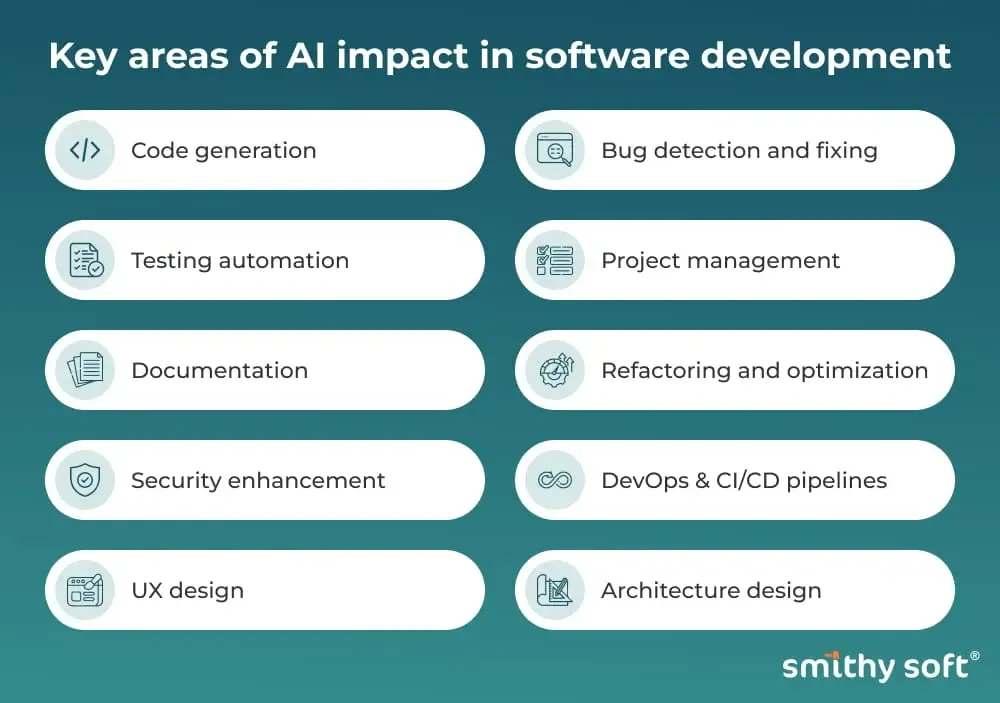
AI is embedded across the entire software development lifecycle, improving speed, quality, and efficiency. Key areas include:
- Code generation – accelerates development by creating boilerplate and feature-level code
- Bug detection and fixing – identifies errors, vulnerabilities, and performance issues early
- Testing automation – generates test cases, covers edge scenarios, and improves QA coverage
- Project management – supports planning, estimation, and risk forecasting
- Documentation – keeps technical and user documentation aligned with the codebase
- Refactoring and optimization – improves code quality and performance without manual effort
- Security enhancement – detects vulnerabilities and enforces best practices
- DevOps & CI/CD pipelines – optimizes deployments, monitors systems, and predicts failures
- UX design – analyzes user behavior and suggests interface improvements
- Architecture design – recommends scalable and cost-efficient system patterns
The rise of AI agents in software development and their limits
AI agents represent the next evolution of artificial intelligence in software development. Unlike traditional AI tools that respond to prompts, AI agents can operate semi-autonomously, executing multi-step tasks, interacting with systems, and adapting their actions based on feedback. They are designed to work continuously within engineering workflows rather than assist with isolated actions.
AI agents are autonomous or semi-autonomous systems capable of planning, executing, and adjusting tasks toward a defined goal. In software development, this means an AI agent can perform sequences of actions – such as analyzing a codebase, generating changes, running tests, and reporting results – without constant human input.
At a technical level, Generative AI – like GPT models – focuses on generating content (text, code, media) in response to a user prompt. It’s stateless, passive, and reactive. In contrast, Agentic AI introduces an entirely new architectural layer: stateful agents that perceive, plan, act, and learn.
What’s more, agents can communicate with other agents, much like distributed services in a microservices architecture. For instance, one agent may specialize in database optimization while another focuses on API security hardening. This mirrors how human software teams divide responsibilities.
Despite their power, AI agents lack true understanding of business context, user intent, and long-term product strategy. They cannot take accountability for architectural decisions, security trade-offs, or ethical considerations. Without human oversight, AI agents may optimize for incorrect goals or introduce hidden risks. That’s why AI agents are powerful assistants – but engineering ownership remains human.
Why human engineers will still be essential in 2026
As of now data pipelines are automated, orchestration is event-driven, and LLMs are embedded into every data tool. Yet, behind all the automation, companies still struggle with the same foundational challenges: poor data quality, inefficient data modeling, governance gaps, rising cloud costs. This means data engineers aren’t being replaced – they’re being amplified. The value now lies in understanding systems end-to-end and aligning automation with business logic.
The automation paradox: as AI gets better at writing basic code, the value shifts entirely to people who can:
- Design system architectures
- Make trade-offs between latency, cost, and accuracy
- Debug complex issues in production
- Optimize AI models for real-world constraints
- Build reliable systems that actually work
- Ensure security, compliance, and ethical considerations
- Interpret user needs and translate them into technical requirements
- Coordinate cross-functional teams and manage engineering workflows
For now it's far from replacing AI engineers by AI. AI is making them more valuable – they are the humans who turn AI’s capabilities into practical, scalable, and high-quality software.
Risks and challenges of AI-driven development
All AI use cases come with risks, and software development is no exception.
Data quality and availability
Poor-quality data leads to inaccurate results, and without sufficient data, AI models can’t perform at their best. For software development teams, this means investing time and resources into gathering, cleaning, and structuring data to ensure the AI has what it needs to function effectively.
Bias
AI trained on biased data can perpetuate discrimination or unfair outcomes in applications, affecting user trust and legal compliance. If training data reflects historical biases, AI models can perpetuate or even amplify discrimination, leading to unfair outcomes. Addressing this issue requires rigorous data governance, diverse datasets, and continuous model evaluation to make sure AI-driven decisions remain fair and unbiased.
Privacy and security
These risks stem from how AI models are trained, how they process information, and how their outputs might inadvertently expose sensitive or proprietary data. AI models trained on large datasets can sometimes reproduce fragments of sensitive data from their training sets, exposing PII, proprietary or confidential information.
Organizations must navigate complex governance frameworks to ensure that sensitive data is handled responsibly, such as customer records, financial transactions, and proprietary business information. Failure to do so can result in compliance violations, reputational damage, and financial penalties.
Insufficient access controls
AI tools often have access to code repositories, databases, cloud infrastructure, or sensitive datasets. If permissions are not properly configured, this can lead to: unauthorized access to sensitive data or intellectual property, accidental exposure of private user information, risk of malicious exploitation or insider threats. Implement strict role-based access controls, audit logs, and least-privilege policies. Ensure AI agents or tools only access what is strictly necessary for their tasks.
Lack of contextual understanding
AI cannot fully grasp business, user, or regulatory context, which may result in recommendations that are technically correct but misaligned with real-world needs.To mitigate this risk, always involve human engineers, product managers, and domain experts in reviewing AI outputs.
Misaligned objectives
AI optimization may prioritize metrics that do not match business goals, such as speed over maintainability or accuracy over scalability. Set clear objectives and constraints for AI to follow. Define priorities like scalability, maintainability, and ROI, and continuously review AI outputs to ensure they support real business outcomes, not just isolated metrics.
IT infrastructure integration
Many organizations struggle to integrate AI systems with their existing IT infrastructure, which may not be equipped to handle the processing power, storage, and scalability demands of AI workloads. Legacy systems can present compatibility issues, making it difficult to seamlessly incorporate AI-driven applications. Businesses must assess their infrastructure needs, invest in cloud-based or hybrid solutions, and confirm they have the computational resources necessary to support AI initiatives.
Cost management issues
AI-driven development often relies on cloud infrastructure, large datasets, and computation-heavy models. Without careful oversight, this can lead to unexpectedly high cloud bills, inefficient resource usage, and budget overruns. Teams may spin up multiple environments, run large training jobs unnecessarily, or leave AI agents running continuously, all of which inflate costs. Solution: set budgets and alerts, optimize resource usage, and regularly review AI workloads to prevent unnecessary cloud spending.
Shadow AI
According to the Harness State of Software Delivery 2025 report, 52% of developers admit to using unsanctioned AI tools, creating security, compliance and intellectual property risks.This can lead to security vulnerabilities, inconsistent practices, data leaks, and compliance issues, as unmonitored AI workflows bypass organizational controls. Solution: establish clear policies, approved tools, and monitoring to ensure all AI usage is secure, compliant, and aligned with business standards.
Resistance to adoption
Teams may resist using AI due to fear of job loss, lack of skills, or distrust in AI recommendations, which can slow integration, reduce efficiency gains, and limit the impact of AI initiatives. Solution: provide clear guidance, hands-on training, and explain how AI supports – not replaces – human roles. Encourage collaboration between engineers and AI tools to build trust and maximize effectiveness.
Conclusions
When it comes to software development, AI is making waves. But with all this growth comes both exciting opportunities and new challenges. Businesses are excited about the potential to streamline processes, boost productivity, and create innovative solutions. But there are also hurdles to tackle, security concerns, integration challenges, and figuring out how to make it all work in the real world.
We help companies navigate the AI-driven transformation of software development. By combining AI capabilities with human expertise, SmithySoft empowers engineering teams to:
- Accelerate development while maintaining high quality
- Optimize workflows across planning, coding, testing, and deployment
- Ensure security, compliance, and ethical best practices
- Build scalable, reliable software without losing control over critical decisions
In 2026 and beyond, our approach ensures that AI acts as a powerful assistant, while human engineers remain in control, making smarter, faster, and more informed software development possible. Contact us!