 Set as preferred source


Investing in AI can feel a lot like buying a fishing rod. On its own, the rod doesn’t catch any fish - it’s merely a tool with potential. Success depends on much more: choosing the right fishing spot, using the right bait, having the skill to cast effectively, and knowing when to reel in. In the world of business, AI is that fishing rod. It doesn’t automatically generate value. To catch the real “big fish” - measurable ROI - you need a clear strategy, the right environment, skilled professionals, and the patience to let results mature.
ROI stands for “Return on Investment,” a term that attracts the interest of every CEO and decision-maker. ROI is one of the crucial metrics that decides the success or failure of a business.
Just as a seasoned angler studies the waters, understands the habits of the fish, and carefully times each cast, businesses must evaluate their markets, define precise objectives, and apply AI thoughtfully. Without this combination, even the most advanced AI technology risks being underutilized or misaligned with business goals.
Let's explore how to define business goals, prepare data, select and develop models, deploy solutions effectively, and sustain long-term value. Think of it as your map to the most promising fishing spots, with the right bait and expert guidance to maximize every investment in AI.
Why ROI matters in AI application development
When businesses talk about AI, the conversation quickly shifts from “What’s possible?” to “Is it worth it?” That shift underscores why Return on Investment (ROI) is such a critical metric for AI application development. ROI is not an abstract buzzword - it’s a quantifiable measure that shows whether your AI initiative is delivering business value relative to its cost.
Fundamentally, ROI answers the question: Did this investment produce more value than it consumed?
ROI calculations can be difficult because many of the beneficial impacts of AI are abstract, indirect and don’t materialize in the short term. The real-time ROI of AI adoption is often challenging to detect. And any immediate gains might be deceiving.
AI investments are rising rapidly - but returns are not guaranteed
Organizations are pouring money into AI at unprecedented rates. By 2026, global corporate investment in AI technology is projected to reach $2.5 trillion, with expectations to climb even higher in the following years. Yet despite this massive financial commitment, many companies struggle to see measurable returns. Some recent industry data suggests:
- Less than 20% of organizations actually achieve significant financial returns from their AI initiatives, even though most have adopted AI in some form (Forbes).
- In some reports, as many as 95% of companies report zero ROI from generative AI implementations due to poor integration or misaligned strategy (IT Pro).
- Only about 10% of organizations using advanced autonomous AI technologies realize substantial ROI within early timeframes (Deloitte).
These figures reveal a stark reality: while interest and investment in AI are high, successful monetization of AI capabilities is not automatic. Without a strategy centered on ROI, AI remains a cost center rather than a value driver.
Hard vs Soft ROI in AI investments
Hard ROI is the tangible gains from an investment. Common examples include: operational cost reduction through automation of repetitive tasks, increased revenue driven by personalized recommendations or improved sales forecasting, lower error rates in processes such as document processing or fraud detection, reduced labor costs in customer service through AI-powered assistants.
Because hard ROI is easy to quantify, it often becomes the primary justification for launching AI initiatives - especially during early adoption stages.
Soft ROI includes other benefits that, while not immediately linked to profits, are still good for the organization. These can include increased employee morale and an improved customer experience. For example, improved customer satisfaction can increase retention rates, while better internal analytics can help leadership make more strategic business decisions.
Focusing solely on hard ROI can lead organizations to underestimate the true value of AI.
The most successful companies evaluate AI investments using a combined ROI framework, which considers both:
- Short-term financial gains (hard ROI)
- Long-term strategic benefits (soft ROI)
Together, these metrics provide a more accurate picture of how AI contributes to business performance. Hard ROI demonstrates immediate economic value, while soft ROI reflects improvements in efficiency, innovation, and competitiveness that compound over time.
Key steps in building an AI application
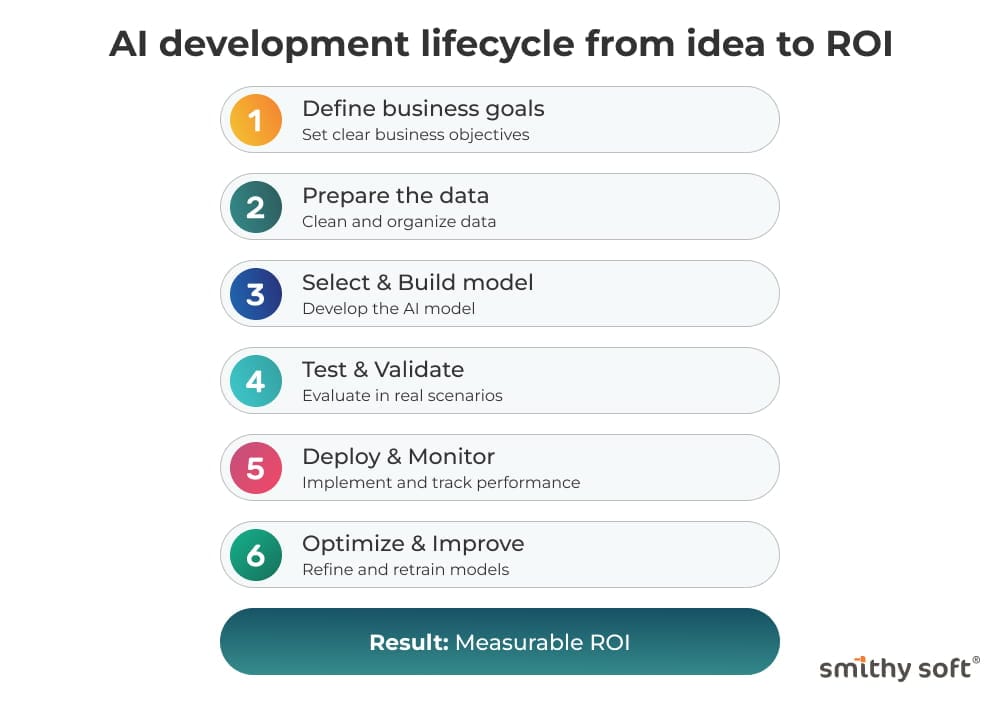
Creating AI applications that deliver measurable ROI requires a structured and disciplined approach. While each organization’s journey will differ depending on industry, resources, and business objectives, successful AI initiatives typically follow a consistent lifecycle - from identifying the right problem to deploying and continuously improving the solution.
Below is a practical roadmap outlining the key phases of building an AI application.
1. Define business goals
Every successful AI project begins with a clear understanding of business objectives. Many AI initiatives fail because they start with technology rather than a clearly defined business problem.
During the discovery phase, organizations must identify the processes they want to improve, the decisions they want to automate, or the inefficiencies they aim to eliminate. This stage typically involves collaboration between business stakeholders, domain experts, and AI engineers.
Key questions include:
- What specific business outcome are we targeting?
- Which processes or decisions can AI improve?
- How will AI reduce costs, increase revenue, or improve customer experience?
- Which KPIs will define success?
Defining these goals early ensures the AI initiative is purpose-driven rather than technology-driven. It also helps prioritize use cases with the highest potential ROI.
Another critical step during discovery is use case feasibility analysis. Not every problem is suitable for AI. Teams should evaluate whether the problem truly requires AI or could be solved with simpler automation or analytics.
2. Prepare the data
Data is the foundation of every AI system. Without high-quality and well-structured data, even the most advanced models will fail to produce reliable results.
Organizations must evaluate several aspects of their data ecosystem:
- Data Availability: Is there sufficient historical data to train models effectively?
- Data Quality: Are datasets clean, consistent, and representative of real-world conditions?
- Data Accessibility: Can the data be easily integrated into the AI pipeline?
- Data Governance: Are there privacy, security, or regulatory constraints?
Investing in data preparation early reduces the risk of biased models, inaccurate predictions, and costly project delays.
3. Select & build model
Once the data foundation is in place, the next step is selecting the appropriate AI model or algorithmic approach.
Different business problems require different types of models, including:
- Supervised learning for prediction and classification tasks
- Unsupervised learning for pattern discovery and clustering
- Reinforcement learning for dynamic decision-making environments
- Generative models for content creation or conversational interfaces
The goal is to select a model that balances performance, maintainability, and operational cost.
4. Test & validate
Before deployment, the AI model must be rigorously tested and validated to ensure it performs reliably in real-world scenarios.
Testing typically includes:
- Evaluating performance metrics such as precision, recall, and F1-score
- Testing edge cases to ensure stability under unusual conditions
- Assessing bias and fairness to prevent discriminatory outcomes
- Validating system integration with existing workflows
Many organizations implement an MVP (Minimum Viable Model) or pilot phase to validate performance before scaling the solution across the organization. This stage significantly reduces risk and ensures that the AI solution delivers measurable value.
5. Deploy & monitor
Deployment is not the end of the AI lifecycle - it marks the beginning of continuous improvement. Unlike traditional software, AI systems must adapt to changing data patterns and evolving business environments. This requires robust monitoring and lifecycle management.
Key monitoring practices include:
- Tracking prediction performance over time
- Detecting data drift or changes in input patterns
- Monitoring model drift and performance degradation
- Maintaining stable integration with operational systems
Equally important is organizational adoption. Even the most accurate AI model will fail to deliver ROI if employees do not trust or use it. Effective training, change management, and integration into business workflows are therefore essential for long-term success.
6. Optimize & improve
AI systems should evolve continuously as new data becomes available and business conditions change. Optimization may involve:
- Retraining models with updated datasets
- Improving feature engineering
- Fine-tuning model parameters
- Expanding the system to support new use cases
Continuous improvement ensures that AI solutions remain accurate, efficient, and aligned with business goals over time.
Organizations that treat AI as an evolving capability - supported by the right processes, infrastructure, and expertise - are far more likely to generate sustainable ROI from their AI investments.
AI development costs: what influences the budget
AI software development cost is influenced by various fundamental elements. Understanding these will help businesses plan their budgets better. Costs can vary widely depending on several factors:
- Data acquisition and preparation: cleaning, labeling, and structuring data can consume up to 60% of the project budget.
- Talent and expertise: AI engineers, data scientists, and domain experts command premium salaries.
- Infrastructure and tools: cloud services, GPUs, and specialized AI platforms can represent a significant investment.
- Model complexity: advanced models, such as deep neural networks, increase computational costs and development time.
- Maintenance: AI solutions require continuous monitoring and updates, which are recurring expenses.
The cost of AI software development increases relative to the range of features and capabilities provided. Therefore, the cost of implementing AI can range from a basic version to a more advanced, feature-rich option.
Overall, simple AI models may start at around $5,000, while more complex solutions - especially those utilizing deep learning - can range from $50,000 to over $500,000 depending on the scope and infrastructure requirements.
Common mistakes that reduce ROI
Despite massive investments, many AI initiatives fail to deliver measurable returns. According to recent studies, less than 20% of AI projects achieve significant financial ROI, while many stall at pilot stages or underperform relative to expectations.
Understanding and avoiding the common mistakes that reduce ROI is critical for companies aiming to turn AI investments into lasting business value.
1. Starting with technology instead of business goals
Many organizations adopt AI because it is trending, without clearly defining the business problem they aim to solve.
Why it reduces ROI:
- AI projects may consume time and budget without addressing pressing business needs.
- Teams risk building technically impressive models that don’t generate measurable value.
How to avoid it:
- Define clear objectives: reduce costs, improve customer experience, or increase revenue.
- Identify key performance indicators (KPIs) that link AI outcomes to business goals.
- Prioritize use cases with the highest potential impact.
2. Ignoring data quality
Data is the foundation of AI. Poor-quality, incomplete, or biased data leads to inaccurate predictions, unreliable insights, and lost business value.
Why it reduces ROI:
- Models trained on low-quality data may fail in real-world scenarios.
- Correcting errors post-deployment can be costly and time-consuming.
How to avoid it:
- Audit and clean your datasets thoroughly.
- Label and structure data carefully for supervised learning.
- Implement data governance practices to ensure compliance and security.
3. Overcomplicating AI models
Some organizations believe that the more complex the AI model, the better the results. This is not always true.
Why it reduces ROI:
- Complex models require more computational resources and longer development cycles.
- Maintenance costs increase, and interpretability often decreases.
How to avoid it:
- Start with simpler models that solve the problem effectively.
- Consider operational feasibility, scalability, and explainability.
- Iterate and refine models gradually.
4. Failing to integrate AI into business processes
Even a highly accurate AI model cannot deliver ROI if it does not fit into existing workflows.
Why it reduces ROI:
- Employees may not use or trust AI outputs.
- Insights remain underutilized or disconnected from decision-making.
How to avoid it:
- Integrate AI outputs with operational systems like CRMs, ERPs, or customer service platforms.
- Ensure employees understand how to act on AI insights.
- Align AI solutions with workflow objectives rather than forcing workflow changes.
5. Neglecting change management
AI implementation often changes roles, responsibilities, and ways of working. Without proper change management, adoption suffers.
Why it reduces ROI:
- Employees may resist using AI tools.
- Low adoption prevents the organization from realizing expected benefits.
How to avoid it:
- Communicate the purpose and advantages of AI solutions clearly.
- Provide training and ongoing support to employees.
- Involve teams in testing and feedback loops to increase trust.
6. Overlooking maintenance and monitoring
AI is not a one-time deployment. Models degrade over time due to changes in data, markets, or customer behavior.
Why it reduces ROI:
- Model drift can decrease prediction accuracy, leading to poor decisions.
- Lack of monitoring increases long-term costs and reduces value.
How to avoid it:
- Implement continuous monitoring and evaluation of model performance.
- Use MLOps practices to automate retraining, testing, and deployment.
- Schedule regular updates to keep AI aligned with business objectives.
7. Failing to measure ROI properly
Without clear metrics, organizations cannot know whether AI projects deliver value.
Why it reduces ROI:
- Investments may continue in underperforming initiatives.
- Success is difficult to quantify, making it harder to justify budgets.
How to avoid it:
- Establish KPIs for both hard ROI (cost savings, revenue gains) and soft ROI (productivity improvements, strategic benefits).
- Review results regularly and adjust strategies as needed.
- Align ROI measurement with business priorities from the outset.
Key takeaway: Technology alone does not guarantee success. ROI comes from combining AI with strategy, skilled teams, disciplined processes, and ongoing evaluation.
How to choose the right AI development partner
Selecting the right AI development partner is one of the most important decisions in any AI initiative. While the technology itself plays a critical role, the success of an AI project often depends on the expertise, processes, and strategic understanding of the team implementing it. A strong partner helps translate business goals into practical AI solutions while minimizing risks and ensuring measurable ROI.
When evaluating potential AI partners, businesses should consider several key factors:
1. Technical expertise and experience
A reliable AI partner should have experience in machine learning, data engineering, cloud infrastructure, and system integration. AI rarely exists as a standalone system - it must work seamlessly with existing products, databases, and workflows.
2. Business understanding
AI development should always be tied to business outcomes. The best partners go beyond writing code - they help identify high-impact use cases, define measurable success metrics, and ensure the solution aligns with your company’s strategic goals.
3. End-to-end development capabilities
AI projects involve multiple stages, from discovery and data preparation to model development, deployment, and monitoring. Working with a partner that can support the entire lifecycle reduces complexity and improves project consistency.
4. Transparent processes and communication
Clear planning, predictable delivery cycles, and transparent communication are essential. Strong development teams follow structured workflows and provide visibility into risks, timelines, and technical decisions throughout the project.
How SmithySoft can help
SmithySoft is a full-cycle software engineering and AI development partner capable of delivering on every stage highlighted in this guide.
We offer hands-on support across the entire AI development lifecycle: helping businesses define clear objectives, prepare and govern data, design and implement scalable models, integrate AI into existing systems, train teams for adoption, and continuously monitor and optimize AI performance. This ensures projects avoid common pitfalls and deliver sustainable, measurable ROI.