 Set as preferred source


AI coding tools are rapidly changing how software is built. What once took weeks can now be prototyped in hours, and almost anyone can turn an idea into a working app using AI.
But there’s a gap between a working demo and a production-ready system.
AI-generated apps are typically built around ideal conditions - clean data, predictable flows, and minimal load. Production environments are the opposite: messy inputs, concurrent users, integrations, failures, and strict security constraints. What works in a controlled demo often hasn’t been tested against these realities.
That’s why things break. Not because the code “doesn’t work,” but because it wasn’t designed for real-world complexity.
How engineering teams close this gap - and what it actually takes to make AI-generated apps production-ready - is what we’ll explore next.
The rise of AI-generated software
AI is writing more code than ever before. Today, 70–90% of developers use AI in their workflow, and in some teams up to 40–60% of code is AI-assisted. What once took weeks can now be prototyped in hours.
This shift is powerful. It reduces time-to-market, lowers the barrier to entry, and enables faster iteration. But it also introduces a new dynamic: more software is being created faster than it can be properly engineered.
The iIllusion of "working software"
AI coding assistants - Gemini, Codeium, Cursor, GitHub Copilot - have made it incredibly easy to generate working code. Combined with platforms like Vercel AI, Retool, Glide, or Firebase Studio, building a functional app no longer requires deep engineering expertise.
Need an admin panel with authentication? Generated in minutes.A SaaS dashboard with charts? Scaffolded instantly.An API with database integration? One prompt away.An AI support bot? Up and running the same day.
And it works.
The demo is smooth. The flows are complete. It feels like a real product.
That’s where the illusion begins.
AI generates code that works in demos. What it doesn’t generate is everything required for production: resilience, scale, and failure handling.
And that’s exactly where things start to break.
Where AI-generated apps usually break
The issues don’t appear immediately. They surface when the app meets real users, real data, and real scale.
- Weak system architecture
AI-generated code often lacks clear structure. Components are tightly coupled, responsibilities are unclear, and there’s no foundation for scaling or extending the system.
- Scalability problems
What works for 10 users fails at 1,000. Without proper load handling, caching, or queueing, performance degrades quickly.
- Security vulnerabilities
Authentication, authorization, and data protection are often implemented superficially. This creates risks -rom data leaks to unauthorized access.
- Database inefficiencies
AI may generate working queries, but not optimized ones. Poor indexing, redundant queries, and incorrect data modeling lead to slow performance and instability.
- Dependency and integration issues
Third-party services, APIs, and libraries introduce fragility. Version mismatches or API changes can break the system unexpectedly.
- Missing error handling
Failures aren’t anticipated. When something goes wrong, the system doesn’t degrade gracefully - it crashes or behaves unpredictably.
- Performance bottlenecks
Latency, memory leaks, and blocking operations are rarely addressed in generated code, but become critical under load.
In fact, a large share of production incidents come from edge cases and integration failures - areas AI rarely anticipates.
Why does AI fail at system design?
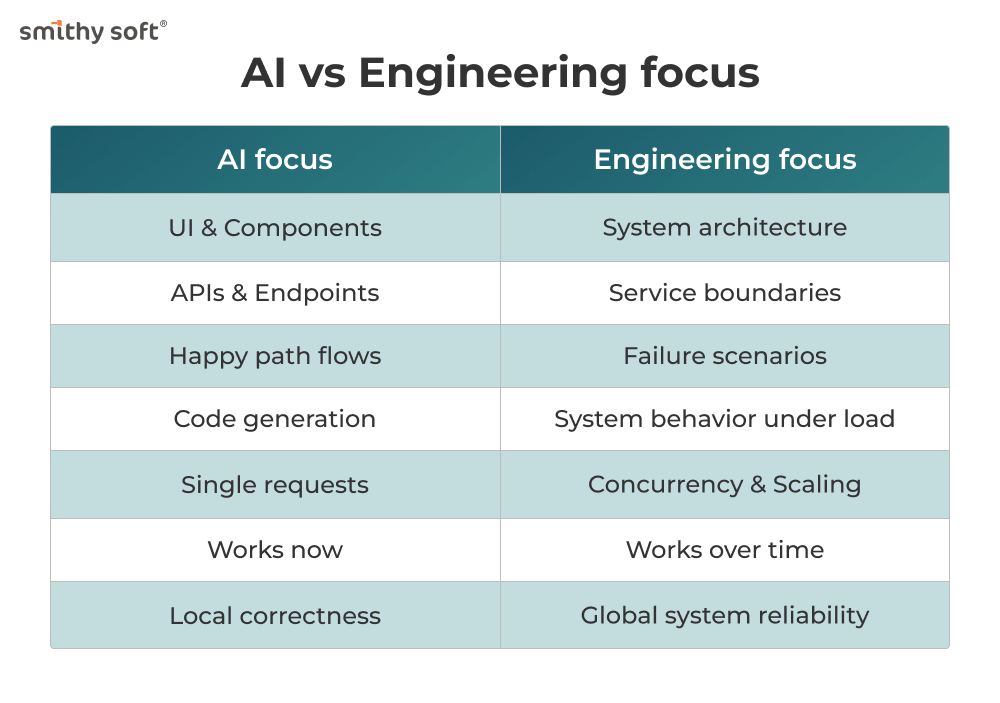
AI is trained to generate code, not to design systems. It optimizes for local correctness - functions, endpoints, components - but not for global behavior. It doesn’t define system boundaries, plan for failure modes, or consider how a system evolves over time.
This is the core limitation: AI can assemble parts, but it doesn’t take responsibility for how those parts behave together under real conditions.
Engineering expertise still matters
AI helps you build faster—but it doesn’t tell you how to build correctly.
Production systems fail not because of missing features, but because of poor decisions:
- how data flows between services
- how APIs handle failures and retries
- how authentication and access control are enforced
- how the system behaves under load
These are engineering problems, not coding problems.
This is where specialists make a critical difference. They:
- design system architecture (monolith vs microservices, service boundaries)
- choose the right data models and database strategies
- implement caching, queues, and load handling
- ensure proper error handling and fallback mechanisms
- enforce security practices across the system
- add monitoring and alerts to detect issues early
AI writes code. Engineers decide how the system actually works—and whether it will survive in production.
How engineering teams use AI safely
The most effective teams don’t avoid AI - they control how it’s used.
They treat AI as a productivity tool, not as a source of truth. Generated code is never assumed to be correct or production-ready by default.
1. AI is used for acceleration, not decision-making
Teams use AI to generate boilerplate, draft functions, or explore approaches - but key decisions are always made by engineers.
AI suggests. Engineers decide.
2. Every AI-generated output is reviewed
AI code is treated like junior-level code. It goes through: code review, refactoring, validation.
Nothing goes directly into production without human approval.
3. AI is integrated into existing workflows
Instead of creating separate “AI pipelines,” teams embed AI into: CI/CD, code review, processes, testing workflows.
This ensures consistent quality standards.
4. Testing is mandatory - not optional
AI-generated code is always tested: unit tests, integration tests, edge cases.
Teams assume the code works for the happy path—and verify everything else.
5. Security and compliance are verified explicitly
AI may generate working logic, but teams validate: authentication flows, access control, input validation.
Especially in regulated industries, no AI-generated code bypasses security checks.
Across companies, the pattern is the same:
- AI accelerates implementation
- Engineers control architecture and quality
- Standard engineering processes remain unchanged
How engineering teams prevent production failures
Engineering teams prevent production failures by anticipating real-world conditions from the start - designing systems not just to work, but to handle scale, errors, and unpredictable behavior reliably.
Weak architecture → Defined system design
Instead of letting AI “assemble” the system, engineers design architecture upfront: define service boundaries, separate responsibilities, plan data flow.
AI then fills in components inside a controlled structure.
Scalability issues → Load-aware design
Engineers plan for scale from the beginning: introduce caching layers, use queues for async processing, optimize database access.
For example, instead of a direct request-response flow, heavy tasks are offloaded to background jobs - something AI rarely does by default.
Security gaps → Explicit security layers
AI may generate auth flows, but engineers enforce: role-based access control
input validation, secure data handling.
In production, security is not a feature - it’s a system-wide concern.
Database problems → Proper data modeling
Instead of relying on generated queries, engineers: design schemas intentionally, add indexes, prevent N+1 queries and bottlenecks.
This is critical once real data volume grows.
Missing error handling → Failure-first design
AI assumes success. Engineers assume failure. They implement: retries and timeouts
fallbacks, circuit breakers.
So when something breaks, the system degrades gracefully instead of crashing.
No observability → Built-in monitoring
AI doesn’t add visibility. Engineers do. They implement: logging, metrics, alerts.
This allows teams to detect and fix issues before users notice them.
Fragile integrations → Resilient interfaces
Instead of trusting external APIs blindly, engineers: handle timeouts and rate limits, version integrations, isolate third-party failures.
This prevents external issues from taking down the entire system.
Conclusion
AI has made building software faster and more accessible - but it hasn’t removed the complexity of production systems.
The gap isn’t in the code itself. It’s in everything around it: architecture, failure handling, scalability, and real-world behavior.
AI can generate working applications. Engineering is what makes them reliable. The teams that understand this won’t just ship faster - they’ll build systems that actually survive in production.
At SmithySoft, we help teams stabilize and scale AI-built apps - resolving architecture gaps, performance issues, and production risks.