
 Set as preferred source


In 2026, early-stage investment is no longer about betting on what could work - it’s about backing teams that already know how to build, measure, and grow. 2026 introduces a sharper focus on execution, efficiency, and technical maturity.
Investors are no longer funding potential alone - they are funding proof of capability.
That's why just a good idea and a pitch deck are no longer enough. Let’s take a closer look at what truly convinces investors.
How are investor expectations changing in 2026?
In 2026, investor expectations have shifted from potential-first to execution-first. While vision and market size still matter, they are no longer sufficient on their own. Investors now prioritize evidence that a startup can build, operate, and scale efficiently in real-world conditions.
Why? Because, to survive and win today, startups must become bigger, faster, and better—addressing large total addressable markets, demonstrating rapid yet sustainable growth, and maintaining strong unit economics.
The strongest founders go beyond showcasing what they have built so far. They help investors clearly understand where the business is headed next. Where is the company today, and where can it realistically be in 12, 18, or 24 months? Founders who can answer these questions with clarity, credibility, and data are the ones most likely to secure investment.
So the main changes are as follows:
- From ideas to proof: in earlier years, a compelling concept and strong narrative could secure early funding. In 2026, investors expect evidence - working products, early users, measurable traction, or validated demand. Assumptions must be tested, not just articulated.
- From growth at any cost to sustainable growth: іnvestors now prioritize capital efficiency, realistic unit economics, and disciplined scaling. Startups are expected to grow with clear cost controls rather than aggressive burn rates.
- From generic teams to execution-ready teams: strong founding teams are still critical, but investors now assess operational maturity earlier. Technical leadership, decision-making speed, and the ability to ship consistently are key signals of long-term viability.
- From static roadmaps to adaptive execution: markets change faster than ever. Investors want to see startups that can iterate quickly, respond to feedback, and adjust strategy without losing focus.
- From promise to predictability: ultimately, investor confidence in 2026 is built on predictability - how reliably a team can deliver results, manage risk, and convert momentum into growth.
Product readiness: more than just an MVP
As we said above, having an Minimum Viable Product (MVP) is no longer a differentiator - it is the baseline. While an MVP is designed to validate an idea and test core assumptions, investors now expect something more mature: an investment-ready product.
*Read more about SaaS MVP: What is a SaaS MVP and why is it important for investors?
An MVP proves that a problem exists and that a solution is technically possible. An investment-ready product, however, demonstrates that the solution works reliably in real-world conditions. It shows stability, usability, and a clear understanding of how the product will scale beyond early adopters.
The key difference lies in depth and readiness. MVPs often rely on manual processes, limited functionality, and temporary architectural decisions. Investment-ready products, on the other hand, are built with scalability, security, and maintainability in mind. They may still be evolving, but the technical foundation is sound and future growth has been carefully considered.
For investors, this distinction matters. A product that is ready for investment signals that the team is past experimentation and moving into execution. It reduces technical risk, shortens the path to market expansion, and increases confidence that additional capital will translate into measurable growth - not just more development time.
In short, MVPs validate ideas. Investment-ready products validate teams, execution capability, and long-term potential.
Technical factors investors care about
The technical aspects of a startup matter greatly to investors - not to examine every line of code, but to evaluate risk, scalability, and the team’s ability to execute over the long term. Early technical decisions shape how fast a company can grow, how much it will cost to scale, and how difficult future changes will be.
Architecture is one of the first things investors assess. They look for a clear, well-structured system that separates core components, avoids unnecessary complexity, and supports future growth without constant rewrites. A flexible architecture signals that the team is thinking beyond the MVP stage.
Maintainability is equally important. Investors pay attention to how easy it will be for new engineers to onboard, understand the codebase, and make changes. Clean code, consistent patterns, and reasonable technical debt indicate a product that can evolve without slowing the team down.
Scalability goes beyond handling more users. Investors want to see that performance, infrastructure costs, and data growth have been considered from the start. Even if the product is not yet operating at scale, the foundations should make scaling predictable and manageable.
Documentation is often overlooked but highly valued. Clear technical and product documentation reduces dependency on individual engineers and lowers operational risk. For investors, it is a signal of maturity and disciplined execution.
Finally, investors focus on early decisions that are difficult to change later - such as core technology choices, data models, and system boundaries. These decisions can either enable rapid growth or become long-term constraints. Teams that understand these trade-offs and can justify their choices inspire far greater confidence.
The role of the engineering team in fundraising
In software development, the engineering team is the group of developers and managers responsible for the actual production and building of the given product or service. They are the ones carrying out all of the sprints and working on new or necessary features, updates, and fixes. Much of what the customer uses and experiences with the end product is built and/or maintained by the engineering team.
The engineering team is the key signal of execution capability and long-term growth potential for investors. A strong, cohesive team can make the difference between a concept that attracts interest and one that actually secures funding.
Investors assess whether the team can deliver on the product roadmap, iterate quickly, and respond to market feedback. Engineers who can showcase rapid development cycles, reliable releases, and continuous improvements provide tangible proof that the startup can execute beyond the idea stage.
Engineering teams also help translate technical achievements into business value. By articulating how architecture choices, scalability strategies, and technical optimizations impact growth, efficiency, and customer experience, engineers strengthen the startup’s pitch.
Ultimately, investors are investing in people as much as ideas. A strong engineering team demonstrates that potential technical challenges—scaling, maintenance, security—are manageable, reducing the perceived risk of the investment.
Scalability expectations before real growth starts
When investors talk about scalability, they don’t mean a product that can instantly handle millions of users - but they do expect a foundation that can grow without breaking. On an early-stage startup, “enough scalability” means the system is thoughtfully designed, flexible, and maintainable, even if it hasn’t yet been tested at full scale.
Investors don’t require perfect architecture at this stage. They understand that startups are still learning, iterating, and refining the product. What they cannot accept, however, is technical chaos - messy code, inconsistent practices, or decisions that will make scaling costly or slow later.
The goal is balance: the startup demonstrates that the system can evolve and support growth efficiently, while leaving room for improvement and iteration. This signals to investors that the team is capable of managing complexity responsibly as the product gains traction.
Common technical red flags that raise investor concerns
In fact, there can be many such red flags for investors - from business model flaws to weak leadership and legal risks. Investors don’t expect perfection, but these red flags signal execution risk. Here are 10 common technical red flags for investors:
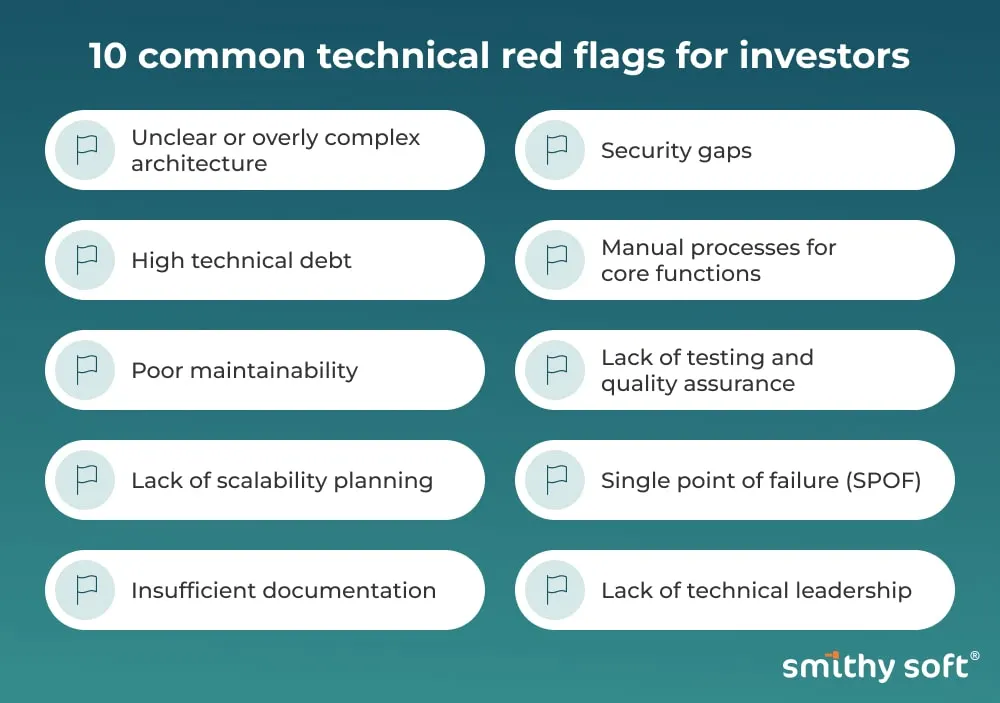
1. Unclear or overly complex architecture
Investors notice when the system lacks a clear structure or has tangled dependencies. This increases technical risk and slows future development.
Solution: Document your architecture using diagrams and descriptions. Show modular design, separation of concerns, and plans for scaling. Keep it simple but future-proof.
2. High technical debt
Quick fixes, messy code, or outdated frameworks signal that future maintenance and scaling will be costly.
Solution: Prioritize refactoring and adopt coding standards early. Track technical debt and include a roadmap for resolving it alongside feature development.
3. Poor maintainability
Inconsistent code style, lack of testing, or missing standards makes onboarding new engineers difficult.
Solution: Implement coding guidelines, peer reviews, and automated testing. Maintain consistent design patterns to ensure code is readable and maintainable.
4. Lack of scalability planning
Investors worry when a product can’t handle growth without major rework or downtime.
Solution: Design systems with scalability in mind from the start—use modular architecture, cloud-native services, and load testing. Document scaling strategies clearly.
5. Insufficient documentation
Missing technical documentation (APIs, workflows, infrastructure) signals that knowledge is siloed.
Solution: Keep living documentation for code, architecture, and operational processes. Tools like Confluence, Notion, or inline documentation in code repositories help maintain clarity.
6. Security gaps
Unencrypted data, missing access controls, or no compliance practices make a product risky.
Solution: Implement basic security practices early: encryption, role-based access control, secure coding standards, and vulnerability scanning. Consider security as a continuous process, not a one-time task.
7. Manual processes for core functions
Core workflows rely on manual intervention, which increases operational risk and reduces reliability.
Solution: Automate repetitive processes using scripts, CI/CD pipelines, or workflow automation tools. Show investors that operations can scale without constant human intervention.
8. Lack of testing and quality assurance
Few or no automated tests mean errors or regressions may go undetected, risking product reliability.
Solution: Implement unit, integration, and end-to-end testing. Continuous testing pipelines and code coverage metrics provide confidence in code quality.
9. Single point of failure (SPOF)
Key knowledge, processes, or infrastructure depends on a single engineer or component.
Solution: Ensure shared ownership of code, cross-training for critical systems, and redundancy in infrastructure. Use version control and knowledge-sharing practices to distribute expertise.
10. Lack of technical leadership
Investors are concerned if no one is responsible for architecture, technical strategy, or long-term decisions.
Solution: Clearly define technical leadership roles, such as CTO or lead engineers. Demonstrate a roadmap for technical decisions, scalability, and evolving the stack.
Fundraising readiness is about reducing risk
Technical risks are one of many for investors. Investors have no shortage of opportunities, which means they also have the luxury of being highly selective. A single red flag - whether in financials, leadership, or governance - can be enough for them to walk away.
Fundraising readiness is less about perfection and more about demonstrating that risks are understood, managed, and minimized. Investors evaluate startups through the lens of risk reduction. They want to know that technical, operational, and market risks have been considered, and that the team has taken steps to mitigate them. This includes:
- Technical risk: Clear architecture, maintainable code, scalable systems, and robust security practices.
- Execution risk: Evidence that the team can deliver on the roadmap, iterate based on feedback, and respond to unforeseen challenges.
- Market risk: Validation of product-market fit, early traction, and understanding of customer needs.
- Financial risk: Capital efficiency, predictable burn rate, and realistic growth projections.
Don't forget also that a strong team is a major factor in investor decision-making. If leadership lacks relevant experience, struggles to communicate a clear vision, or appears unable to execute, investors will think twice. The strength of a startup’s team is a critical factor in determining its potential success.
And finally, here are some practical keys:
- Nothing scares investors off faster than a company that can’t provide clear, reliable financials. Inconsistent revenue numbers, unexplained expenses, or a lack of audited statements suggest deeper issues beneath the surface.
- Without a well-defined revenue model, monetization strategy, and scalability potential, long-term success is uncertain.
- Investors evaluate not only the product but also the team. If there are conflicts among co-founders, it’s a serious red flag.
- If the founding team lacks relevant experience in their industry, investors will question their ability to execute the project.
- Investors want to see clean ownership structures and clear legal frameworks. If a startup has multiple past investors with unclear agreements or unresolved equity disputes, new investors will hesitate to get involved.
- Investors need evidence that your solution resonates with real users.
- Implement security best practices. Even at early stages, encrypt sensitive data and enforce access controls. Show awareness of compliance requirements relevant to your industry.
- Communicate risks and mitigation. Be transparent with investors about known challenges and your solutions. Shows maturity, planning, and credibility, which reduces perceived risk.
Conclusions
In 2026, investors fund execution, not just ideas. A strong MVP alone is no longer enough—startups must show that they can build, operate, and scale effectively while minimizing risk.
Ultimately, fundraising readiness is about reducing uncertainty for investors and showing that the startup can grow responsibly and efficiently.
At every stage of this process, SmithySoft supports startups in building scalable, investment-ready products and preparing for investor pitches. We help founders demonstrate traction, reduce risk, and present their business with confidence to secure funding. Let SmithySoft help you reduce risk and impress investors - reach out today!