 Set as preferred source

What Is a Unicorn Company and Why Does It Matter?
Unicorn Company is a private startup valued at over $1 billion. In other words, the company has reached a valuation of $1 billion without being publicly listed on any stock market.
Unicorns derive their value from investor assessments participating in the financial rounds of these companies. Since all unicorns are startups, investors primarily base their value on growth potential and expected development.
The Origin of the Unicorn Startup Term
The term was first introduced by venture capitalist Aileen Lee in 2013. She wrote about them in her article “Welcome to the Unicorn Club: Learning from Billion-Dollar Startups,” discussing software startups founded in the 2000s, and she calculated that only 0.07% of them reach a $1 billion valuation.
At that time, only 39 companies were identified as unicorns. According to Lee, startups that achieve this milestone are so rare that finding one is as difficult as finding a mythical unicorn.
As of early February 2024, Crunchbase Unicorn had recorded 1509 unicorn companies worldwide.
Countries and Cities With the Most Unicorn Companies
The top 10 countries with the most unicorn companies today look like this:
- The USA – 735 unicorns
- China – 275
- India – 87
- Great Britain – 59
- Germany – 39
- France – 29
- Canada – 27
- Israel – 26
- South Korea – 21
- Singapore – 20
Тоp industries by Unicorn Counts look like this:
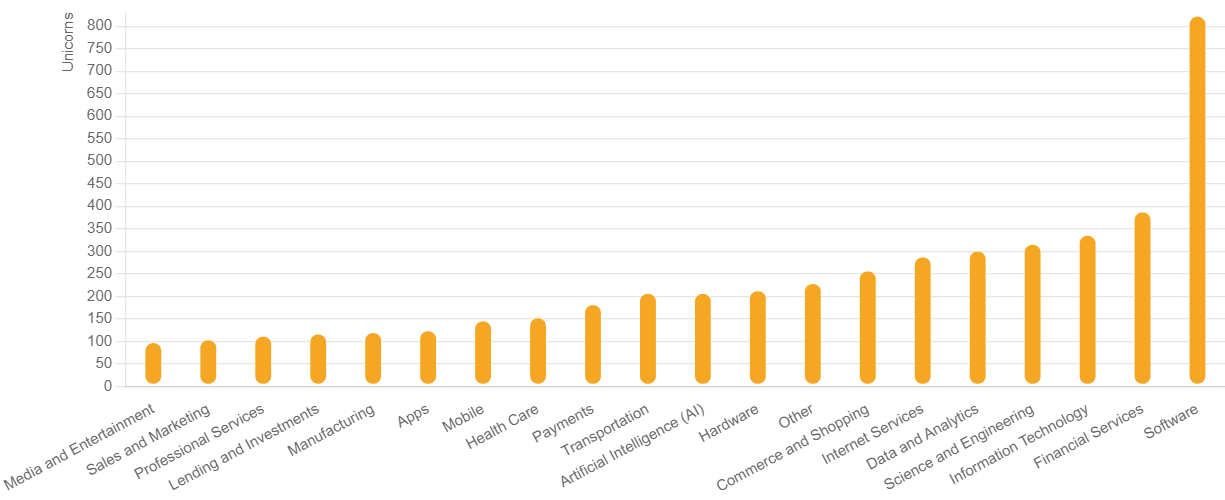
So, the software industry is undeniably a leader in creating unicorns, followed by financial services and information technology.
Artificial intelligence and energy are the sectors with the highest number of new unicorns in 2023.
Cities with the Most Unicorns in the World (by Startup Blink):
San Francisco, United States – 256
New York, United States – 119
Beijing, China – 51
London, United Kingdom – 39
Los Angeles, United States – 37
Shanghai China – 36
Boston, United States – 33
Bangalore, India – 31
Paris, France – 28
Tel Aviv-Yafo, Israel – 23
Notable New Unicorn Startups of 2023
Crunchbase records a quantitative decrease in new unicorns compared to 2022 when 300 companies joined this unique list.
The most expensive new unicorn companies of 2023 include:
- CoreWeave from New Jersey, a cloud infrastructure company valued at $2.2 billion;
- Xpansiv, an energy infrastructure and commodity research platform based in San Francisco, raised a direct investment round valuing it at $2 billion;
- ShiftKey, based in Dallas, a planning and accreditation platform for healthcare workers, raised $2 billion in direct capital.
Other new American companies joining the unicorn list include:
- Atmosphere, a streaming television platform based in Austin, provides packaged television for restaurants, bars, gyms, and doctors’ offices;
- Adept AI, a San Francisco-based company working in human-computer interaction;
- Character.ai, a competitor to ChatGPT based in Menlo Park, California;
- Colossal Biosciences, a Dallas-based de-extinction company.
Among the new foreign unicorn companies are the Chinese: Huasun Energy, Astronergy, and Yuze Semiconductor, the German company, DeepL, which specializes in artificial intelligence language translation, the Cairo-based credit and payment company MNT-Halan, and the joint French-Irish solar energy production company Amarenco joined the list.
The Most Valuable Unicorn Companies in the World
According to Crunchbase data, the largest unicorn company in the world is ByteDance, valued at $220 billion. ByteDance, based in Shanghai, China, is an internet technology company that operates creative content platforms like TikTok.
Also, Ant Group, valued at $150 billion; SpaceX, valued at $125 billion; Shein, valued at $66 billion; and Reliance Retail, valued at $63 billion, are included in the top five worldwide.
Among the top five American unicorn companies by valuation is SpaceX, valued at $125 billion; Stripe, valued at $50 billion; Instacart, valued at $39 billion; Databricks, valued at $38 billion; and Juul, valued at $38 billion.
Common Traits of Successful Unicorn Startups
There is no standard formula for creating a successful unicorn startup. However, some characteristics are present in many of them. For example:
- Breakthrough innovation
These companies are capable of creating innovative products or services that challenge existing market norms. In doing so, they offer customers higher value. For example, Uber changed the way people travel. Airbnb changed how people plan their accommodations while traveling, and Snapchat disrupted the use of social media, and so on. - Pioneers, innovators
It is evident that unicorns are predominantly pioneers in their field. They constantly push boundaries and think outside the box to create new products and services that change the way we live and work. - Technically savvy
Unicorns leverage the advantages of available technologies and software to scale their business. The use of technology and artificial intelligence enables companies to work more efficiently with fewer resources. AI can be used for process automation, providing personalized user experiences, improving customer service, and so on.
For example, DoorDash uses artificial intelligence for logistics, and Kabbage uses artificial intelligence to disrupt the banking industry. Nearly 90% of unicorns provide software products. - Consumer-oriented
Over 62% of unicorns are B2C companies – businesses for consumers. Their goal is to simplify and make things easy for consumers and become part of their everyday lives. Making things affordable is another paramount point for these startups. For example, Spotify has made music listening easier for the world. - Experience
Unicorn companies are typically founded by experienced entrepreneurs. It’s a myth that all unicorn founders are under 30; many are older, sometimes much older. A common thing for these founders is that they possess previous work experience and an “entrepreneurial DNA,” meaning the unicorn company is usually not their first business. They have a deep understanding of their industry and know how to overcome the challenges implied by building a successful business. They have a clear vision for their business, know what they want to achieve, and have a roadmap for how to get there. Unicorn companies also have a strong team.
Alternatives to Unicorns: What Are Decacorns, Dragons, and Minotaurs?
The surge in technology investment in the private market has led to the emergence of new jargon terminology used to evaluate startups. SoFi Learn provides a table where you can find other “racers” similar to unicorns according to other financial criteria of companies.
| Startup Term | Definition |
|---|---|
| Pony | Company worth less than $100 million |
| Racehorse | A company that became unicorn very quickly |
| Unitortoise | A company that took a long time to become a unicorn |
| Narwhal | Canadian company with a valuation of at least $1 billion |
| Minotaur | A company that has raised $1 billion or more in funding |
| Undercorn | A company that reached a $1 billion valuation then fell below it |
| Decacorn | Company with a valuation of at least $10 billion |
| Hectocorn | Company with a valuation of at least $100 billion |
| Dragon | A company that returns an entire fund, meaning the single investment paid off as much as a diversified portfolio |
Is Unicorn Status Still a Big Deal?
So, if once unicorns were rare, now they have greatly multiplied and turned into whole herds. And seriously, creating a unicorn company is considered a significant achievement in the startup world. It demonstrates that the company has successfully raised significant amounts of capital and has a promising future. There is such hope. But it is not necessary. Not all unicorn companies succeed in the long run, and many do not live up to the lofty expectations set by their valuations.
At the same time, being a unicorn is no longer enough. Investors are interested in startups of the top league – decacorns. The status of “unicorns” has been blurred by inflation - this is how the current large number of unicorn companies is explained. But decacorns are already in a higher league. These are private companies valued at over $10 billion. There are a little more than 40 of them in the world. So far...