 Set as preferred source


Cloud computing has become an indispensable part of business operations. As businesses continue moving infrastructure, applications, and data into the cloud, one challenge becomes impossible to ignore: rising and unpredictable cloud expenses.
Cloud platforms promise flexibility, scalability, and speed — but without the right financial strategy, they can also introduce waste, inefficiency, and budget overruns. This is where FinOps comes in.
What is FinOps?
FinOps (short for “Finance + DevOps”) is a cloud financial management practice that helps organizations control, monitor, and optimize their cloud spending while maintaining high performance and innovation. The goal is to provide transparency and control over cloud costs.
FinOps is a framework and practice that helps organizations align cloud usage and costs with business goals. FinOps brings business leadership, finance, product and engineering teams together to ensure that cloud spending is aligned with business goals.
FinOps is not a package or service, but rather a FinOps solutions framework. It is also not exclusive to a certain type of company, as the member count of the FinOps Foundation, a non-profit for groups that use the FinOps model, exceeds over 800 companies. This includes national banks, financial institutions and music streaming services.
Why FinOps is so important?
1. Smart and transparent cost management
FinOps ensures that cloud spending is intentional and data-driven. Instead of cutting costs blindly, teams eliminate waste while keeping the resources that truly matter for performance and scalability.
2. Accurate forecasting and predictable budgeting
With real-time dashboards, usage analytics, and spending insights, FinOps enables organizations to forecast costs more precisely and avoid unexpected budget overruns.
3. Shared responsibility across teams
FinOps aligns engineering, finance, and operations under one framework. This shared accountability helps teams make balanced decisions between performance, cost, and business value.
4. Continuous waste reduction and infrastructure optimization
By monitoring cloud usage patterns, identifying idle or oversized resources, and applying rightsizing or savings plans, FinOps ensures the cloud environment remains efficient and cost-effective.
5. Accelerated innovation without overspending
FinOps empowers teams to experiment, deploy quickly, and scale confidently — knowing they have the data and processes needed to keep spending under control.
FinOps principles
The FinOps Foundation has introduced 6 core principles designed to guide organizations in effectively aligning their internal FinOps practices. These principles serve as a roadmap, ensuring your FinOps implementation is heading in the right direction.
These principles are in no particular order, and they should be taken as a whole.
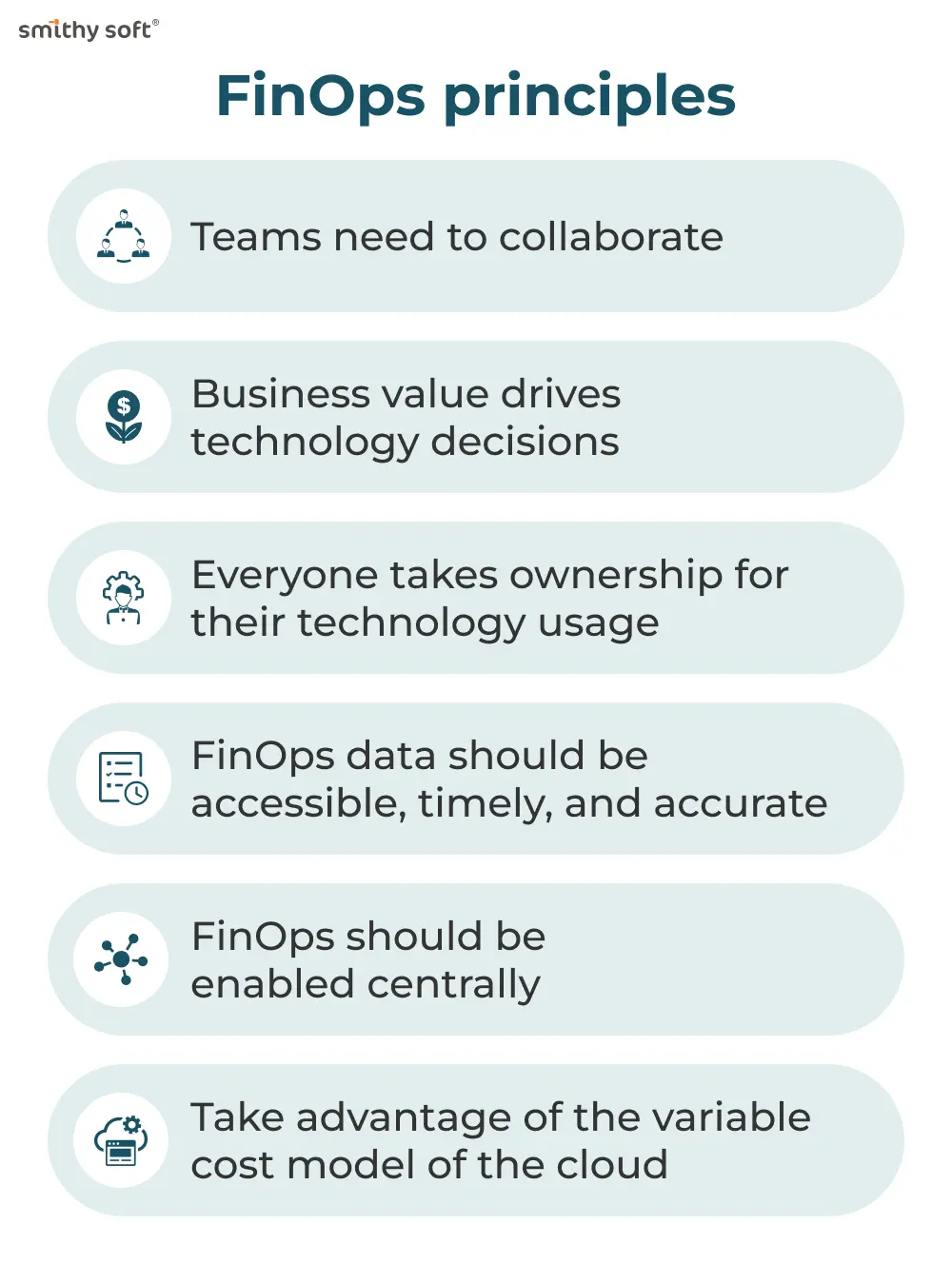
Teams need to collaborate
Finance, technology, product, and business teams work together in near real time as the cloud operates on a per-resource, per-second basis. Teams work together to continuously improve for efficiency and innovation.
Business value drives technology decisions
Unit economic and value-based metrics demonstrate business impact better than aggregate spend. Make conscious trade-off decisions among cost, quality, and speed. Think of FinOps Scopes as a driver of business value.
Everyone takes ownership for their technology usage
Accountability of usage and cost is pushed to the edge, with engineers taking ownership of costs from architecture design to ongoing operations. Individual feature and product teams are empowered to manage their own usage of cloud and intersecting technologies against their budget. Decentralize the decision making around cost-effective architecture, resource usage, and optimization. Technical teams must begin to consider cost as a new efficiency metric from the beginning of the software development lifecycle.
FinOps data should be accessible, timely, and accurate
Process and share cost data as soon as it becomes available. Real-time visibility autonomously drives better cloud and technology utilization. Fast feedback loops result in more efficient behavior. Consistent visibility into cloud and technology spend is provided to all levels of the organization. Create, monitor, and improve real-time financial forecasting and planning.
FinOps should be enabled centrally
The central team encourages, evangelizes, and enables best practices in a shared accountability model, much like security, which has a central team yet everyone remains responsible for their portion of technology use. Remove the need for engineers and operations teams to think about rate negotiations, allowing them to stay focused on usage optimization of their own environments.
Take advantage of the variable cost model of the cloud
The variable cost model of the cloud should be viewed as an opportunity to deliver more value, not as a risk. Embrace just-in-time prediction, planning, and purchasing of capacity. Agile iterative planning is preferred over static long-term plans. Embrace proactive system design with continuous adjustments in cloud optimization over infrequent reactive cleanups.
FinOps vs Traditional cost management
While both FinOps and traditional cost management aim to control spending, they operate in fundamentally different ways — especially in the context of cloud computing. The cloud introduces dynamic, fast-changing, pay-as-you-go costs that traditional financial approaches were never designed to handle.
Below are the key differences:
| Aspect | FinOps | Traditional Cost Management |
|---|---|---|
| Timeframe |
• Real-time visibility • Immediate alerts for spikes • Continuous monitoring |
• Monthly or quarterly reports • Delayed awareness of issues • Reactive approach |
| Responsibility Model |
• Shared across engineering, finance, operations • Teams own their cloud spend • Collaborative decision-making |
• Primarily owned by finance • Engineers lack cost accountability • Siloed decision-making |
| Optimization Approach |
• Ongoing optimization cycle • Rightsizing, autoscaling, scheduling • Savings plans and reserved instances |
• Periodic cost reviews • Manual adjustments • Limited optimization activities |
| Financial Model Fit |
• Designed for dynamic, pay-as-you-go cloud models • Adapts to scaling workloads • Suitable for multi-cloud environments |
• Built for fixed, predictable budgets • Assumes stable workloads • Struggles with cloud variability |
| Decision-Making Focus |
• Business value and ROI • Performance-vs-cost trade-offs • Data-driven decisions |
• Mainly cost reduction • Budget compliance focus • Limited visibility into value |
| Culture and Collaboration |
• Cross-functional teamwork • Transparency across departments • Shared KPIs and dashboards |
• Departmental silos • Limited communication • Finance and engineering disconnected |
| Tools & Automation |
• Automated dashboards and cost alerts • Tagging and governance tools • Real-time analytics |
• Manual reporting • Limited automation • Basic financial tools |
FinOps practices and tips
Whether you’re just starting your FinOps journey or looking to level up your cloud cost strategy, here are the best FinOps practices and actionable tips to help you get the most value from every dollar spent.
1. Build a FinOps team
Some companies call this team a Cloud Center of Excellence, while others call it the FinOps Team. For many, the team may not have a special title, and it could include a cross-functional team dedicated part-time.
This group should be a governing body that provides best practices and develops KPIs and metrics to help teams understand the unit economics of the business. Engineers, product owners, and finance teams must collaborate and share responsibility for cloud costs.
2. Enable real-time cost visibility
You can’t optimize what you can’t see. Real-time (or near real-time) visibility allows teams to identify cost anomalies and take action before issues snowball. Tips: Use cloud provider tools like AWS Cost Explorer, Azure Cost Management, or Google Cloud Billing. Implement tagging and labeling standards to track workloads accurately. Set up automated alerts for unusual spikes.
3. Establish clear KPIs
Without clear KPIs it’s difficult to measure the success of your FinOps activities. Start with clearly defining key performance indicators that align with your financial goals and objectives. The next step is to establish measurable targets for each KPI to track progress and success. That’s done, ensure that KPIs include metrics related to cost efficiency, such as cost savings percentage and return on investment (ROI).
4. Utilise cost allocation tags
Tagging is foundational for FinOps. Clear, consistent tags unlock cost allocation, showback/chargeback, and resource optimization. Leveraging cost allocation tags serves to attribute cloud costs to specific resources, projects, teams, or departments. Introducing a culture of ownership of the cloud costs reinforces awareness and thinking about cloud spending. To utilise the tags, start with developing and implementing a comprehensive tagging strategy for cost allocation. Use tags to attribute costs to specific projects, teams, or departments for improved accountability. To ensure consistency and accuracy automate the tagging process.
5. Enforce cloud resources optimisation
Enforcing cloud resources optimisation involves systematically ensuring that cloud resources are used efficiently, cloud costs are minimised, and performance is optimised. Oversized instances are one of the most common (and expensive) cloud waste issues. Implement sizing strategies based on actual usage, regularly identify and eliminate unused or underutilized resources to reduce cloud costs, use spot instances and reserved capacity to maximize cost savings.
6. Leverage commitment discounts wisely
Savings plans, reserved Instances, and committed use discounts can reduce costs significantly — but only when used properly. Analyze long-term usage patterns before purchasing commitments. Start with partial commitments to minimize risk. Revisit commitments regularly as workloads evolve.
7. Eliminate waste and unused resources
Unused or forgotten resources silently drain your budget. Look for ways to reduce waste. For example, remove any legacy resources that are not being used. A $100 per month storage bucket that hasn’t been used in four years costs $1,200 per year — almost $5,000 for the four years. While this might seem insignificant for a multi-million dollar business, multiple instances of such applications add to a significant expense. Common sources of waste: Idle virtual machines, unattached storage volumes, overprovisioned kubernetes clusters, old snapshots and logs.
8. Measure unit cost to understand cloud efficiency
Instead of looking only at total cloud spend — which can increase simply because your business is growing — unit cost reveals how efficiently you are using cloud resources relative to a meaningful business output. Unit cost transforms cloud costs from a confusing spreadsheet into a business performance metric. By focusing on how much value you deliver per dollar spent, organizations gain clearer insight into efficiency, identify opportunities for optimization, and align engineering decisions with financial outcomes.
9. Conduct regular FinOps assessments
Regular FinOps assessments help organisations ensure alignment with financial goals in the ever-changing environment, optimise cloud costs, and identify opportunities for improvement. Establish a schedule for regular reviews, considering the cadence of your organisation’s operations. Evaluate the performance of established KPIs and adjust strategies based on the outcomes. Regularly assess the accuracy of cost allocation to ensure alignment with business initiatives. Identify new opportunities for optimisation based on industry trends, technology advancements, and changes in cloud service offerings.
10. Foster a сulture of сontinuous FinOps education
A mature FinOps practice requires ongoing education to ensure that all stakeholders — engineers, product managers, finance teams, and leadership — stay informed about evolving cloud technologies, pricing models, and optimisation strategies. Continuous learning empowers teams to make cost-conscious decisions and supports long-term organisational efficiency.
How to implement FinOps in Your organization
Step 1. Start with a clear vision and executive support
Before diving into tools or processes, define why you need FinOps. Are costs growing too quickly? Do you lack visibility? Are teams making independent infrastructure decisions without financial context?
Communicate the business value of FinOps to leadership. Executive sponsorship ensures proper prioritization, removes organizational barriers, and accelerates adoption across teams.
Step 2. Build the FinOps team
With your FinOps proposal approved, this stage focuses on building the foundation for effective implementation by setting up the team, processes, and collaboration framework.
Define the FinOps function’s structure and roles, integrating it with existing teams like the Cloud Center of Excellence. Decide which roles will be filled internally or externally and prioritize responsibilities to maximize efficiency.
FinOps is a team sport. Create a FinOps function that includes representation from: engineering, finance, cloud operations / DevOps, product and business units.
Step 3. Establish processes
The FinOps team should establish processes for cost management, cost allocation, budgeting, forecasting, and optimization of cloud resources. These processes should be standardized, repeatable, and scalable to ensure consistency and efficiency.
Step 4. Choose tools
The team should select the appropriate tools to support the FinOps processes. These tools should provide visibility and control over cloud costs and usage, automate manual tasks, and enable collaboration among team members.
Step 5. Optimize cloud resources continuously
Once visibility and allocation are in place, begin optimization efforts: right-size over-provisioned instances, remove unused resources (idle VMs, unattached volumes, old snapshots), use auto-scaling to match capacity with demand, leverage spot instances or reserved capacity when appropriate. Optimization should be an ongoing practice, not a one-time task. The goal is to give stakeholders timely, accurate information about their cloud usage and spend.
Step 6. Create processes for budgeting and forecasting
FinOps helps finance teams better predict cloud spending and align it with budgets. To support accurate forecasting: combine historical spending data with usage growth trends, introduce forecasting models for each team or product, ensure that engineering provides input on upcoming changes. This promotes better planning and reduces end-of-quarter surprises.
Step 7. Continuously review, improve, and scale
FinOps is not a “set it and forget it” function. As workloads, teams, and cloud technologies evolve, your FinOps practice should grow with them.
Perform regular assessments to: identify new optimization opportunities, update KPIs and governance policies, refine visibility tools and reporting processes, incorporate new features from cloud providers.
FinOps maturity evolves in stages — crawl, walk, run — so continuous improvement is essential.
Conclusion
💡At every stage of this journey, SmithySoft can provide the expertise and guidance organizations need to advance confidently. Whether you are a startup taking your first steps toward cost visibility, a growing company building structured FinOps processes, or a mature enterprise looking to automate and optimize at scale, SmithySoft supports you with tailored solutions.
SmithySoft provides strategic financial oversight in a cloud-first world. By uniting finance, operations, and technology under a data-driven framework, we optimize cloud spending.