 Set as preferred source


AI is no longer a discrete initiative. Gartner’s 2026 trends read less like a list of emerging tools and more like a blueprint for operating in a persistent AI environment—one where compute constraints, autonomous workflows, and trust failures affect revenue durability and market viability.
The report organizes the 10 trends into three themes: building AI-ready digital foundations, orchestrating multiple AI and non-AI systems for new value, and elevating trust, governance, and security. The central signal is a shift from model-centric advantage to system-level control, where differentiation depends on the ability to operate complex AI environments with predictability at scale.
This briefing translates Gartner’s trend set into structural priorities: where infrastructure becomes a capital decision, where autonomy introduces cost volatility, and where security and sovereignty shift from compliance considerations to market access conditions.
The timing mistake to avoid: “Now” vs “Near”
The most common failure mode in technology strategy is sequencing. Gartner implicitly buckets the trends into adoption horizons—items that function as operational imperatives in the next 1–3 years versus those that mature over a 3–5 year window.
Why this distinction matters is structural. Timing errors tend to produce two outcomes. First, early overinvestment in capabilities that lack governance maturity. Second, delayed investment in foundations and controls that later become prerequisites for scale.
A practical framing emerges:
- “Now” priorities focus on foundations and guardrails: AI-native development platforms, supercomputing and hybrid compute, confidential computing, provenance, preemptive security, and early AI security controls.
- “Near” priorities function as orchestration multipliers: multiagent systems at enterprise scale, consolidated AI security platforms, and physical AI deployments that require organizational and operational readiness.
Not all trends demand immediate execution. Several do.
AI-native development platforms: productivity becomes an operating model
Gartner positions AI-native development platforms as a mechanism for delivering more software with smaller teams. The report cites that 80% of organizations will evolve large software engineering teams into smaller, AI-augmented teams by 2030, and that 40% of enterprise application portfolios will include custom applications built using AI-native platforms by that point, up from 2% in 2025.
The implication is not simply faster coding. It is a restructuring of throughput economics:
- Software backlogs contract without linear headcount growth.
- The “build vs buy” equation shifts as internal productivity rises.
- Governance pressure moves upstream, as faster delivery amplifies the cost of defects and noncompliance.
AI-native development accelerates output, but only if paired with standards, guardrails, and review mechanisms that scale alongside speed.
AI supercomputing and hybrid architectures: compute becomes strategy
AI supercomputing platforms supply the processing power required for advanced models, combining high-performance computing, specialized processors, and scalable architectures. Gartner notes that 40% of enterprises will adopt hybrid computing architectures by 2028, up from 8%, and that more than 20 vendors will offer unified developer platforms built on supercomputing environments by the same period.
The strategic issue is not “cloud versus on-premises.” It is how optionality is preserved while preventing compute from becoming a bottleneck:
- Workload placement becomes an economic and risk decision, not a technical footnote.
- Unified developer platforms reduce friction across heterogeneous environments.
- Hybrid orchestration evolves into a control plane for cost, performance, and compliance.
Compute capacity increasingly behaves as a resilience asset rather than a utility expense.
Confidential computing: the cloud trust reset
Confidential computing protects data while it is being processed, limiting access even from cloud providers. Gartner projects that 75% of processing in untrusted infrastructure will be secured by confidential computing by 2029.
This trend responds to converging pressures: stricter privacy regulation, data localization mandates, and the expansion of AI into sensitive workflows.
The structural consequences are clear:
- “Data in use” protection becomes a requirement for regulated workloads.
- Key management and attestation shift into core control mechanisms.
- Infrastructure selection increasingly embeds assumptions about sovereignty and auditability.
Confidential computing functions less as a niche security feature and more as an enabler for scaling AI under regulatory constraint.
Multiagent systems: autonomy creates a new cost model
Multiagent systems use collections of specialized agents to execute complex workflows. Gartner reports a 1,445% surge in inquiries from 1Q24 to 2Q25, and projects that 70% of such systems will rely on narrowly specialized agents by 2027, with 60% supporting multivendor interoperability by 2028.
The underappreciated issue is economic rather than technical. Autonomous agents introduce variable compute demand, orchestration overhead, and retry behavior that resists static budgeting.
Gartner flags “unpredictable costs” and the need for observability investment. In practice, this translates into:
- Cost attribution per workflow, agent, and vendor.
- Observability funded as core infrastructure, not an add-on.
- Governance mechanisms capable of halting runaway automation.
As autonomy enters production, cost volatility becomes a structural property of systems.
Domain-specific language models: accuracy and compliance converge
Domain-specific language models are trained on specialized datasets for particular industries or functions. Gartner projects that more than 60% of enterprise GenAI models will be domain-specific by 2028, with 30% of GenAI workloads running on-premises or on-device.
The value proposition centers on control:
- Reduced error rates in critical workflows.
- Faster deployment where general models underperform.
- Stronger alignment with explainability and compliance requirements.
The strategic choice concerns where domain advantage resides—data, fine-tuning, lifecycle management, or monitoring. DSLMs convert governance into a continuous operating function rather than a one-time deployment step.
Physical AI: AI returns to material constraints
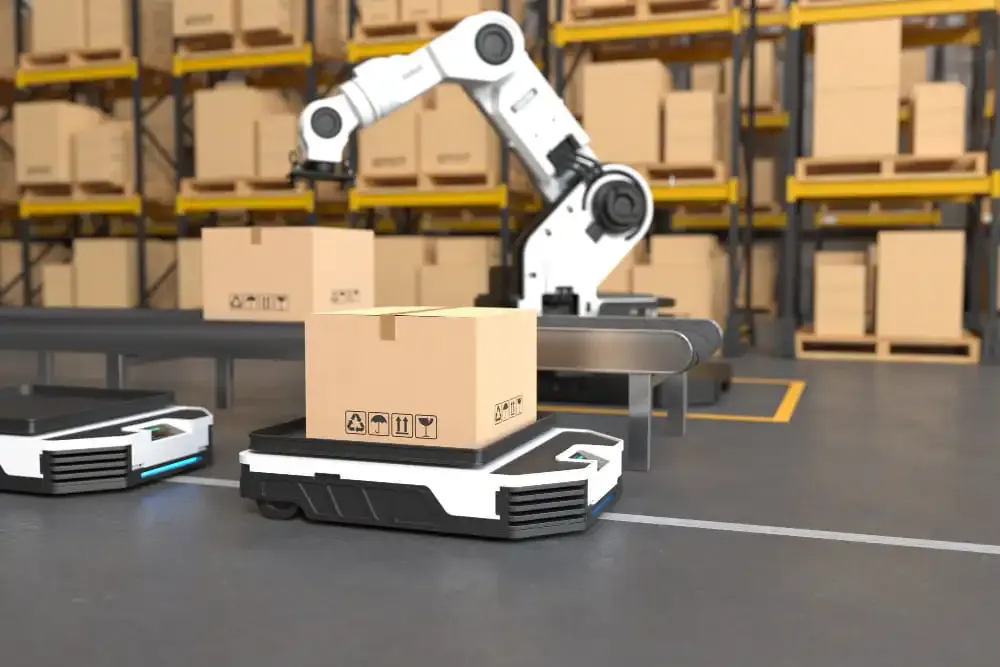
Physical AI embeds intelligence into robots, vehicles, drones, and devices that sense and act. Gartner notes that five of the top 10 AI vendors will offer physical AI products by 2028 and that 80% of warehouses will use robotics or automation by the same period.
This transition shifts AI economics:
- Gains appear as throughput, safety, and uptime improvements.
- Risks manifest as liability, safety exposure, and cyber-physical security.
- Capital expenditure replaces purely software-driven scaling.
Physical AI ties digital capability to material limits—energy, maintenance, regulation—reintroducing friction into expansion paths.
Preemptive cybersecurity: the 3 Ds and market viability
Preemptive cybersecurity uses AI-driven techniques to anticipate and neutralize attacks before execution. Gartner frames this approach around three mechanisms: Deceive, Deny, and Disrupt. The report also states that by 2029, technology products lacking preemptive security will lose market relevance.
Additional signals reinforce the shift: 50% of security software spending is expected to move to preemptive solutions by 2030, while documented vulnerabilities are projected to exceed one million annually.
Security, in this framing, becomes a condition of product viability rather than a support function.
Digital provenance: integrity becomes infrastructure
Digital provenance verifies the origin and integrity of software, data, and media through bills of materials, attestation databases, and watermarking. Gartner links this trend to code tampering, abandoned open-source components, and deepfake-driven disinformation, alongside emerging mandates such as the EU AI Act.
Provenance increasingly functions as infrastructure for trust. In environments saturated with synthetic output, unverifiable artifacts lose value. Traceability becomes a prerequisite for participation.
AI security platforms: consolidation under policy pressure
AI security platforms consolidate controls for third-party AI services and custom applications, addressing risks such as prompt injection, rogue agent behavior, and data leakage. Gartner projects that 80% of enterprises will adopt such platforms by 2028 and that 80% of unauthorized AI transactions will originate from internal policy violations.
The implication is structural. Internal misuse, not external attack, becomes the dominant risk vector. Enforcement therefore shifts from awareness to technical control and observability.
Geopatriation: the sovereignty–agility matrix
Geopatriation involves relocating workloads from global hyperscale clouds to sovereign or local environments to reduce geopolitical exposure. Gartner estimates that 75% of enterprises will geopatriate workloads by 2030.
The decision space forms a matrix:
- Hyperscale benefits: ecosystem scale, global reach, rapid innovation.
- Geopolitical risks: jurisdictional exposure, regulatory fragmentation, dependency concentration.
- Alternatives: sovereign cloud regions, partner-owned environments, regional providers, on-premises or colocation.
Geopatriation emerges not as a one-time migration but as an ongoing capability for workload rebalancing.
Conclusion
Taken together, Gartner’s 2026 trends describe a transition from expansion to control. Innovation persists, but it unfolds within visible constraints—compute, energy, governance, and geopolitics. Advantage accrues to systems that remain coherent under stress, where resilience, observability, and capital discipline outweigh raw speed.
Done well, the trend set functions less as a technology list and more as a map of the operating posture required for the AI era.
If you experience access issues, contact [email protected].