
 Set as preferred source


At first glance, healthcare software may look similar to any other SaaS product: dashboards, user accounts, analytics, APIs. However, under the surface, the level of technical, legal, and ethical complexity is significantly higher.
Healthcare engineering is closer to aerospace or financial infrastructure than it is to consumer SaaS. Because healthcare is one of the most complex industries in the world, and that complexity is reflected in the software solutions designed to serve it.
Healthcare software must handle sensitive patient data and adhere to strict regulations. Unlike other types of software, the stakes are immeasurably higher; an error in a patient management system can lead to serious clinical consequences, not just financial inconvenience.
Why healthcare product engineering is fundamentally different
Developing healthcare software products that are innovative, compliant, and scalable represents a major challenge. Each stage of the development lifecycle brings unique complexities and considerations.
The healthcare industry is tightly regulated. In the US, for example, healthcare IT solutions must comply with a range of different compliance frameworks, including: HIPAA, HITECH, FDA regulations for Software-as-a-Medical-Service (SaMD).
Healthcare products must integrate with fragmented and legacy ecosystems: hospital information systems, laboratory databases, insurance platforms, wearable devices, and government registries. Many of these systems use outdated protocols, inconsistent data formats, or unreliable APIs. Engineers are forced to build complex interoperability layers while maintaining data accuracy and traceability.
Software failures can directly impact patient outcomes. For example, a bug in a clinical decision support system may display outdated treatment guidelines. A synchronization error in an electronic health record (EHR) system may cause incomplete patient histories. A performance issue in a telemedicine platform may interrupt a critical consultation. In each case, engineering mistakes translate into medical risk.
In consumer software, breaking features may result in temporary user frustration. In healthcare, it can result in compromised patient records, incorrect treatment decisions, or legal liability. Reliability and predictability are not optional qualities - they are core product requirements.
Engineering choices in healthcare also play a central role in building trust. Doctors, patients, and institutions rely on these systems for critical decisions. If a platform is unstable, insecure, or inconsistent, users quickly lose confidence. Once trust is damaged, it is extremely difficult to restore. Therefore, architecture, testing strategies, and data governance must be designed with transparency and resilience in mind from the very beginning.
Scalability in healthcare is not only a technical challenge, but also a compliance and safety challenge. As systems grow, they must continue to enforce access controls, audit trails, and data integrity across thousands or millions of users. Poorly designed infrastructure may scale in terms of traffic, but fail under regulatory audits or security stress.
Balancing innovation and compliance in healthcare software
In today’s rapidly evolving healthcare landscape, organizations face a critical challenge: how to leverage innovative AI technologies while maintaining strict compliance with industry regulations. This balancing act is not just about meeting requirements; it’s about creating a framework that enables digital evolution while protecting patient safety and privacy.
Healthcare remains one of the most heavily regulated industries in the world. For software teams, this creates a constant tension between moving forward and staying compliant.
Every new feature, algorithm, or integration must comply with strict standards such as HIPAA, FDA, MDR, and ISO certifications. These frameworks govern how data is collected, stored, processed, and shared. Ignoring them is not an option—non-compliance can lead to legal penalties, reputational damage, and, most importantly, patient harm.
Many startups initially view compliance as a barrier to creativity. Regulatory documentation, validation protocols, and audit requirements seem to slow down development cycles. However, in practice, compliance often strengthens innovation rather than limiting it. Clear regulatory frameworks force teams to design systems that are robust, transparent, and accountable from the start. Instead of building experimental features and fixing problems later, engineers must validate assumptions early and design for long-term reliability.
By adopting a risk-smart approach to digital evolution, healthcare organizations can harness AI’s power while maintaining strict compliance. The key lies in selecting technology platforms that embed compliance into their core architecture, ensuring that innovation and regulation work hand in hand to improve healthcare delivery.
Building compliance into the engineering process
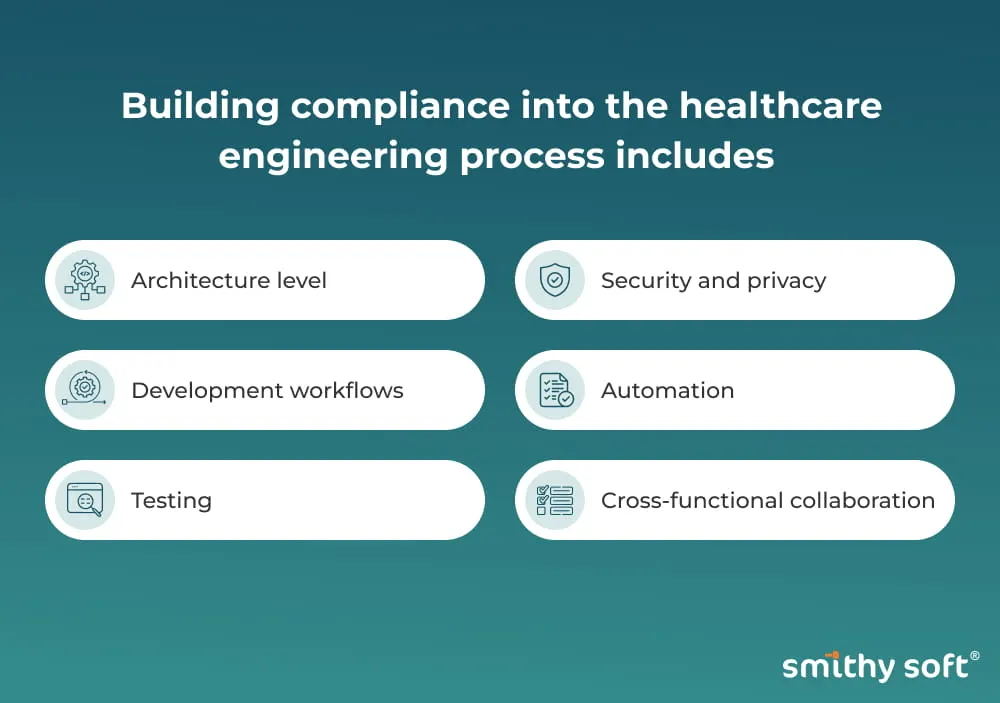
Effective compliance begins at the architecture level. Decisions about data storage, system boundaries, and service communication determine whether a product can meet regulatory standards in the long term. For example, choosing a centralized data model without strong access controls may simplify early development, but it creates major challenges when implementing role-based permissions, audit trails, and data segregation later. Designing for compliance from the start reduces technical and regulatory debt.
Security and privacy should be implemented as default behaviors, not optional features. Encryption at rest and in transit, secure key management, identity verification, and least-privilege access must be part of the core infrastructure. When these mechanisms are added after deployment, they often conflict with existing workflows and degrade system performance.
Development workflows must also support regulatory requirements. This includes maintaining detailed documentation, version control for clinical algorithms, and traceable change histories. Every significant modification should be linked to validation results and risk assessments.
Automation plays a critical role in scalable compliance. Manual reviews and ad-hoc checks do not scale in complex healthcare platforms. Continuous integration pipelines can enforce security scans, dependency checks, and compliance rules automatically. Infrastructure-as-code enables reproducible environments that meet regulatory standards across development, testing, and production.
Testing strategies must extend beyond functional correctness. Healthcare software requires validation against clinical safety, data integrity, and regulatory criteria. This includes stress testing under failure scenarios, verifying backup and recovery procedures, and simulating real-world misuse cases.
Cross-functional collaboration is essential. Engineers, quality assurance teams, legal specialists, and clinicians must share ownership of compliance outcomes. When regulatory responsibility is isolated within a separate department, engineering teams lose visibility into risk factors and design constraints. Integrated governance structures enable faster, safer decision-making.
Finally, building compliance into engineering culture is as important as technical implementation. Teams must be trained to understand regulatory implications of their work and encouraged to raise concerns early. Compliance should be viewed as a professional standard, not an administrative burden.
5 essential healthcare compliance laws you need to know
Patient data protection is paramount in healthcare, and various regulations have been enacted over the years to ensure its security. Understanding healthcare compliance regulations is crucial in navigating the intricacies of the healthcare industry. There are five essential healthcare laws that compliance professionals in the healthcare industry should familiarize themselves with, if they have not done so already.
1. HIPAA (Health Insurance Portability and Accountability Act, 1996)
HIPAA is the cornerstone of healthcare privacy and security regulation in the United States. It dictates how Protected Health Information (PHI) must be stored, accessed, transmitted, and audited.
HIPAA applies to health plans and healthcare providers, business associates that provide services to healthcare providers and have access to or use PHI, teaching institutions that provide medical services, and clearinghouses (external entities that do healthcare billing).
Violations of HIPAA can result in civil penalties of $137 to over $68,928 per violation as well as criminal penalties and possible imprisonment if the violations are intentional. Violators may also be required to correct and overhaul organizational policies to bring them up to HIPAA’s standards.
2. HITECH Act (Health Information Technology for Economic and Clinical Health, 2009)
The HITECH Act complements HIPAA by enhancing penalties for data breaches and promoting the adoption of electronic health records (EHRs). It expanded breach notification rules and increased penalties for non-compliance.
3. AKS (Anti-Kickback Statute)
The AKS makes it a crime to knowingly and willfully offer, pay, solicit, or receive any remuneration directly or indirectly to induce or reward patient referrals for the generation of business involving any item or service reimbursable by a federal healthcare program.
Remuneration includes anything of value and can take many forms besides cash, such as free rent, expensive hotel stays and meals, and excessive compensation for medical directorships or consultancies. In some industries, it is acceptable to reward those who refer business to you. However, in the Federal health care programs, paying for referrals is a crime.
4. Stark Law
The Stark Law, also known as the Physician Self-Referral Law,, is a U.S. federal regulation designed to prevent financial conflicts of interest in medical decision-making. Its core principle is simple: physicians should not profit from referring patients to services they financially benefit from.
In practice, this law has far-reaching implications for healthcare organizations, digital health platforms, and software providers that support clinical and financial workflows.
5. FCA (False Claims Act)
The civil FCA imposes civil liability on any person who knowingly submits, or causes the submission of, a false or fraudulent claim to the federal government. “Knowing” and “knowingly” mean a person has actual knowledge of the information or acts in deliberate ignorance or reckless disregard of the truth or falsity of the information.
The FCA also contains incentives for whistleblowers (called “relators”) to file lawsuits alleging false claims on behalf of the U.S. government (called “qui tam” actions). A private citizen who successfully brings a qui tam action typically receives a portion of the recovery ranging between 15% and 30%.
Qui tam actions comprise a significant percentage of FCA cases. In the healthcare industry, potential whistleblowers could include current and former hospital employees, patients, industry competitors, or others.
Understanding sensitive healthcare data
In healthcare, data is more than just bytes on a server — it represents people’s health, privacy, and trust. Handling it responsibly is both a legal requirement and a core engineering challenge. Understanding the different types of sensitive healthcare data is the first step toward building safe, compliant systems.
Protected health information (PHI) is the cornerstone of healthcare privacy regulation under HIPAA in the U.S. PHI refers to any information that can identify an individual and relates to their health, healthcare provision, or payment for healthcare. This includes both electronic (ePHI) and physical records.
Types of PHI:
- Personal Identifiers: Name, address, Social Security number.
- Medical Information: Diagnoses, prescriptions, lab results.
- Financial Data: Insurance and billing records.
- Biometric Data: DNA, fingerprints, retinal scans.
Key takeaways for engineers:
- All PHI is sensitive by default - it must be protected whether stored on-premises, in the cloud, or in logs.
- Role-based access control is essential - only authorized personnel should view or modify PHI.
- Audit and monitoring - systems must log all access and modifications to support compliance and incident response.
- Encryption and secure transport - both at rest and in transit, PHI must be secured to prevent breaches.
- Minimization - collect only the PHI required for care, treatment, or regulatory purposes.
What successful healthcare engineering teams do differently
Building software for healthcare isn’t just about writing code faster or launching features first. Successful healthcare engineering teams adopt strategies that set them apart from typical SaaS teams.
They are:
1.Prioritize compliance from day one
- Embed compliance checks into every stage of development.
- Use secure-by-design principles in architecture and infrastructure.
- Maintain audit-ready documentation to demonstrate adherence to regulations.
2.Design for trust and safety
- Implement role-based access control and data segregation.
- Monitor systems continuously for anomalies or failures.
- Ensure high availability and disaster recovery plans.
3.Integrate cross-functional expertise
- Include regulatory specialists and clinicians in planning and review.
- Collaborate with security and privacy officers to validate workflows.
- Use shared documentation and automated compliance checks to keep everyone aligned.
4.Build resilient and scalable architecture
- Implement modular and secure data pipelines.
- Maintain consistent access controls across expanding networks.
- Plan for regional regulatory differences, such as GDPR, HIPAA, or PHIPA.
5.Invest in continuous validation and monitoring
- Automate testing for security, privacy, and clinical safety.
- Monitor data integrity and system performance in real time.
- Validate that AI models or analytics outputs remain accurate as data scales.
6.Adopt a compliance-first culture
- Train engineers on regulatory implications of their work.
- Encourage early identification of risks instead of punishing mistakes.
- Treat compliance as a design principle, not an afterthought.
Conclusion
In healthcare, engineering excellence is measured not just by speed or innovation, but by resilience, reliability, and responsible decision-making. Teams that internalize these principles deliver systems that patients, providers, and regulators can trust.
Engineering healthcare products directly affect patient safety, regulatory compliance, and long-term trust. Therefore, architecture, testing strategies, and data governance must be designed with transparency and resilience in mind from the very beginning.
At SmithySoft, we help healthcare organizations build compliant, secure, and scalable software. From HIPAA-ready architectures and data governance frameworks to automated testing and monitoring, we ensure your systems are innovative, safe, and trusted.
Ready to build healthcare software that inspires trust? Contact SmithySoft today and let’s create reliable, compliant solutions together.