
 Set as preferred source


Chief Technology Officer (CTO) as a Service is an alternative hiring model that offers a flexible technical service from a third-party specialist. In situations where a company requires fast intervention from an experienced CTO, this approach allows for quick and efficient technical expertise without additional costs and recruitment efforts.
Think of it as having a tech expert available exactly when you need them, without the costs and commitments of hiring a full-time executive. Instead of going through a lengthy and strenuous recruitment process, you can “borrow” a CTO to deliver on a specific task.
The role of a CTO in a startup
While a Chief Executive Officer (CEO) makes many of the high-stakes business decisions, it is often the CTO who informs those decisions and ensures the company’s product vision becomes reality.
In tech-oriented startups, the CTO often wears multiple hats — co-founder, strategist, and builder. In small, fast-moving teams, the CTO’s role can expand beyond traditional boundaries.
A CTO leads a company’s technology and engineering efforts. Their main responsibility is to use technology to build better products and create long-term value for the business.
At the early stages, the CTO is often deeply involved in building the initial product, selecting the right technology stack, and setting up infrastructure and workflows that allow the team to move fast without compromising quality. They make key decisions about architecture, scalability, and security — all while keeping future growth in mind.
As the startup begins to scale, the CTO’s role evolves from coding and architecture to leadership and strategy. They become responsible for hiring and mentoring the engineering team, defining technical priorities, and aligning technology with business goals. A strong CTO ensures that every technical decision supports the company’s roadmap and helps deliver value to users.
As emerging technologies mature, the CTO is now responsible not just for building products, but also for future-proofing the business through technical resilience and intelligent automation.
How CTO as a Service helps startups accelerate growth
CTO as a Service is a business arrangement where a company hires an external individual or firm to provide CTO-related services on a temporary or contract basis. It’s a flexible alternative to hiring a full-time, in-house CTO.
Hiring a full-time CTO can be a major expense, with salaries ranging from $150,000 to $250,000 per year. For many startups, that’s simply out of reach. That’s where CTO as a Service (CTOaaS) comes in — offering access to the same high-level expertise and guidance, but at 50–60% lower cost.
A fractional or virtual CTO helps startups:
- Build a solid technical foundation — choosing the right stack, architecture, and tools to support future growth.
- Accelerate development by guiding teams, streamlining workflows, and implementing best engineering practices.
- Align technology with business strategy, ensuring that every tech decision supports product-market fit and long-term goals.
- Reduce costs and risks by avoiding early technical debt and inefficient development.
- Scale confidently — from MVP to full-scale product — with a clear roadmap and sustainable infrastructure.
In essence, CTOaaS gives startups the strategic and technical leadership they need when they need it most. And this is its greatest advantage and value.
What is the difference between a full-time CTO and CTOaaS?
While both a full-time CTO and CTOaaS provide strategic technical leadership, they differ significantly in structure, cost, and flexibility.
Here are the main differences between them.
| Aspect | Full-Time CTO | CTO as a Service (CTOaaS) |
|---|---|---|
| Engagement Type | Permanent executive position | On-demand or part-time engagement |
| Commitment Level | Long-term, full-time involvement | Flexible — can be project-based or ongoing |
| Cost | High fixed cost (salary, benefits, equity) | Lower, pay-as-you-go model |
| Availability | Requires recruitment and onboarding | Available immediately via service engagement |
| Scope of Work | Oversees entire tech department, product strategy, and innovation | Focused on specific goals like architecture, MVP development, or scaling |
| Speed of Implementation | Slower — recruitment and integration take time | Fast — instant access to experienced expertise |
| Ideal For | Established startups and enterprises | Early-stage startups or businesses in transition |
| Team Management | Directly builds, hires, and mentors internal tech teams | Provides guidance or interim leadership for existing teams |
| Budget Flexibility | Requires consistent, long-term investment | Adaptable to project size and budget |
| Strategic Involvement | Deep, ongoing participation in company vision and culture | High-level strategic input on-demand |
The main types of CTOs
Not all CTOs play the same role. Depending on the company’s stage, structure, and business goals, a CTO can take on different focuses and responsibilities.
1. The technical visionary
This type of CTO is driven by innovation. They focus on long-term technology strategy, R&D, and adopting emerging tools that give the company a competitive edge. Visionary CTOs often thrive in startups that want to disrupt their market through new technologies like AI, blockchain, or automation.
Best for: Early-stage startups with ambitious, tech-driven products that require deep technical foresight.
2. The operational CTO
Operational CTOs are experts in execution and efficiency. They concentrate on building robust systems, managing infrastructure, and optimizing engineering workflows. Their main goal is to ensure that the product is stable, scalable, and delivered on time.
Best for: Growing startups or scale-ups that already have a product and need to refine or scale their technology stack.
3. The product-focused CTO
This CTO acts as the bridge between technology and customer experience. They align technical decisions with product strategy, working closely with designers, marketers, and user researchers to create a product that truly meets market needs.
Best for: Startups in competitive markets that rely on user experience and rapid feature delivery to stand out.
4. The infrastructure architect
These CTOs specialize in building strong foundations — designing scalable architectures, ensuring security, and managing DevOps pipelines. Their strength lies in planning for growth, reducing technical debt, and preparing the business for future expansion.
Best for: Companies transitioning from MVP to enterprise-level solutions or preparing for high traffic and global reach.
5. The people leader
A people-oriented CTO is focused on team building, leadership, and culture. They mentor developers, set standards for engineering excellence, and create an environment that attracts and retains top talent.
Best for: Established startups or organizations scaling their development teams and fostering strong technical culture.
It’s important to note that every startup’s needs evolve over time — a visionary CTO may be critical at launch, while an operational or product-focused CTO becomes key during scaling. For these reasons CTO as a Service is very useful, because it can bring in the exact type of expertise you need — whether strategic, operational, or product-focused — at the right moment, without long-term commitment.
Four types of CTOaaS employment models
1. On-demand CTO
This is the most flexible option. An on-demand CTO steps in only when needed — for example, to conduct a technical audit, assist during product launch, or consult on architecture and infrastructure.
Best for: Startups that need expert guidance for specific tasks or short-term challenges, without long-term commitments.
2. Fractional CTO
A fractional CTO works part-time with your team on an ongoing basis — typically several hours or days per week. They combine strategic leadership with hands-on involvement in product or technical direction.
Best for: Early-stage startups that need consistent technical oversight and strategic planning but don’t yet require (or can’t afford) a full-time CTO.
3. Temporary or interim CTO
A temporary CTO takes full control of technology leadership for a limited period — often during a transition, such as before hiring a permanent CTO, or when scaling up before funding rounds.
Best for: Companies in transition, undergoing restructuring, or scaling operations that need steady and experienced leadership to maintain momentum.
4. Full-time CTO (via CTOaaS)
Some service providers offer long-term CTOaaS arrangements, where a dedicated CTO works full-time for your company but is officially employed by the service provider but remains officially employed by the service provider. This allows you to have full leadership support without dealing with hiring, HR, or administrative overhead.
Best for: Growing or mature startups that require continuous, full-time technology management with the flexibility of an external partnership.
Benefits of using CTO as a Service
- Cost efficiency without compromising quality: with CTO as a Service, you gain access to the same senior-level expertise on a flexible basis. You only pay for the time or scope of work you actually need — no long-term contracts, no overhead.
- Fast product development: CTOaaS eliminates the months-long process of recruiting a senior executive. An experienced CTO can join your project immediately, helping you accelerate development, optimize architecture, and deliver faster. This speed is crucial for startups aiming to launch MVPs, attract investors, or stay ahead of competitors.
- Flexibility and scalability: CTOaaS gives you full flexibility. You set the rules: You can use CTOaaS for a specific development stage of your startup or the entire project. You can specify the hours per week or month – whatever is best for your business.
- Reduced risk and technical debt: many startups grow fast but without a strong technical foundation, they risk costly rework later. CTOaaS helps avoid this by setting up scalable systems, proper documentation, and best practices from day one. This minimizes technical debt and keeps your product stable as you scale.
- Fresh perspective: working for a company on a regular basis makes a person accustomed to its processes and the way it operates. It's hard to stay alert and open to change when you've been doing things "as always" for years. Support from an external expert provides an objective perspective on technology decisions and strategies, as they are not as deeply involved in the company's internal dynamics and politics. This can lead to more effective decision-making.
- Access to knowledge and proven expertise: CTO as a Service provider typically works with multiple startups across industries — from fintech to e-commerce to SaaS. That means they bring battle-tested experience and a broad understanding of what works (and what doesn’t) in different business environments. You get access to best practices, modern tech stacks, and scalable architectures without trial and error.
- Strategic technology alignment: а great CTO doesn’t just manage developers — they align technology with business goals. With CTOaaS, your startup gains an expert who can help translate your vision into a clear, scalable technology strategy, ensuring that every technical decision supports growth and customer experience.
- Mentorship and team development: beyond strategy and execution, CTOaaS can help mentor your in-house team, build engineering culture, and improve collaboration between technical and non-technical departments. This creates a stronger foundation for future growth.
When should you choose CTOaaS?
You have a great idea, but no technical co-founder
If your founding team is strong on business, marketing, or product vision — but lacks technical leadership — CTOaaS fills that gap.
An external CTO helps you:
- Define a clear product roadmap and technical strategy.
- Choose the right tech stack and tools.
- Manage developers or outsourcing partners.
- Avoid early-stage mistakes that can cost you months later.
💡 Think of CTOaaS as your “temporary tech co-founder” until you’re ready to bring one in-house.
You’re building an MVP and need to move fast
When it’s time to turn your idea into an MVP, CTOaaS helps you build the right product, the right way — scalable, stable, and investor-ready.
They’ll ensure you don’t over-engineer, help prioritize key features, and speed up time to market.
You’re facing technical bottlenecks during development
Whether you need help with system architecture, data migration, cybersecurity, or choosing the right tech stack, an external CTO provides the strategic insight to remove blockers and get development back on track. By filling skill and experience gaps, CTOaaS ensures your product keeps evolving — efficiently, securely, and without unnecessary downtime.
You’re getting ready for fundraising
Investors love clarity — especially around technology and scalability.
A CTOaaS can help prepare your tech documentation, audit your codebase, and build confidence in your product architecture. They can even join investor calls to represent your technical strategy.
💡Having a senior technical expert on your side can make your startup look more mature and credible to investors.
Your tech team needs direction
Many startups begin with a few developers — but without structure, productivity, and quality can drop quickly. A CTOaaS can introduce best practices, processes, and development standards, ensuring your team works efficiently and your product grows in the right direction
You’re scaling and need to level up technology
Once your MVP gains traction, CTOaaS can help you prepare for the next stage — scaling your infrastructure, improving security, and hiring the right tech talent. This allows you to transition smoothly from “startup mode” to “growth mode.”
You need expertise — but can’t afford a full-time CTO yet
A senior CTO’s salary can easily exceed $150K–$250K per year — not counting equity.
With CTOaaS, you get the same level of expertise at a fraction of the cost and commitment. You can scale the engagement based on your budget and business stage.
Why choose SmithySoft for CTO as a Service?
SmithySoft’s CTO as a Service gives you more than technical leadership — it gives you a partner who shares your startup’s vision and drives it forward.
With deep expertise, startup mindset, and flexible engagement models, we help you build products that are scalable, secure, and ready to conquer the market.
We define strategic priorities, manage development processes, and optimize systems to ensure that every digital initiative drives measurable results. By combining expert oversight with agile execution, we help you achieve meaningful growth while maintaining seamless operations across your organization.
What CTO as a Service includes
Tech stack strategy
We help you choose and structure the right tools, frameworks, and platforms for your specific needs. Our goal is to create a modern, scalable tech environment that supports rapid development, seamless integration, and long-term product evolution. Whether you're building from scratch or modernizing, we ensure your stack is efficient, reliable, and ready to grow with you.
Team composition
A strong product needs a strong team. We guide you in building a well-balanced, high-performing development team - defining the right roles, identifying skill gaps, and helping with hiring and onboarding. We also ensure the team structure promotes collaboration, agility, and delivery speed across any working model remote, in-house, or hybrid.
Development budget optimization
Every dollar counts. We help you get the most out of your tech budget by reviewing spending patterns, identifying inefficiencies, and aligning costs with business priorities. This includes optimizing team size, tooling, cloud usage, and vendor contracts to ensure your investments fuel measurable outcomes and sustainable growth.
Architecture review
A solid architecture is the backbone of your product’s performance. We perform a deep audit of your current infrastructure - evaluating scalability, reliability, security, and maintainability. Based on your goals, we offer practical recommendations or lead a redesign to support better performance, faster delivery, and future feature expansion.
Compliance roadmap
We guide you through technical compliance with global standards like GDPR, HIPAA, SOC 2, and others relevant to your industry. From secure data storage to audit-readiness, we create a roadmap that helps your product meet legal requirements, maintain trust, and avoid risks as your user base grows.
Effective tech team management
We bring structure and clarity to your development process by implementing proven management practices. From agile workflows and sprint planning to documentation standards and communication frameworks, we help your team stay focused, aligned, and productive.
Our Process CTOaaS
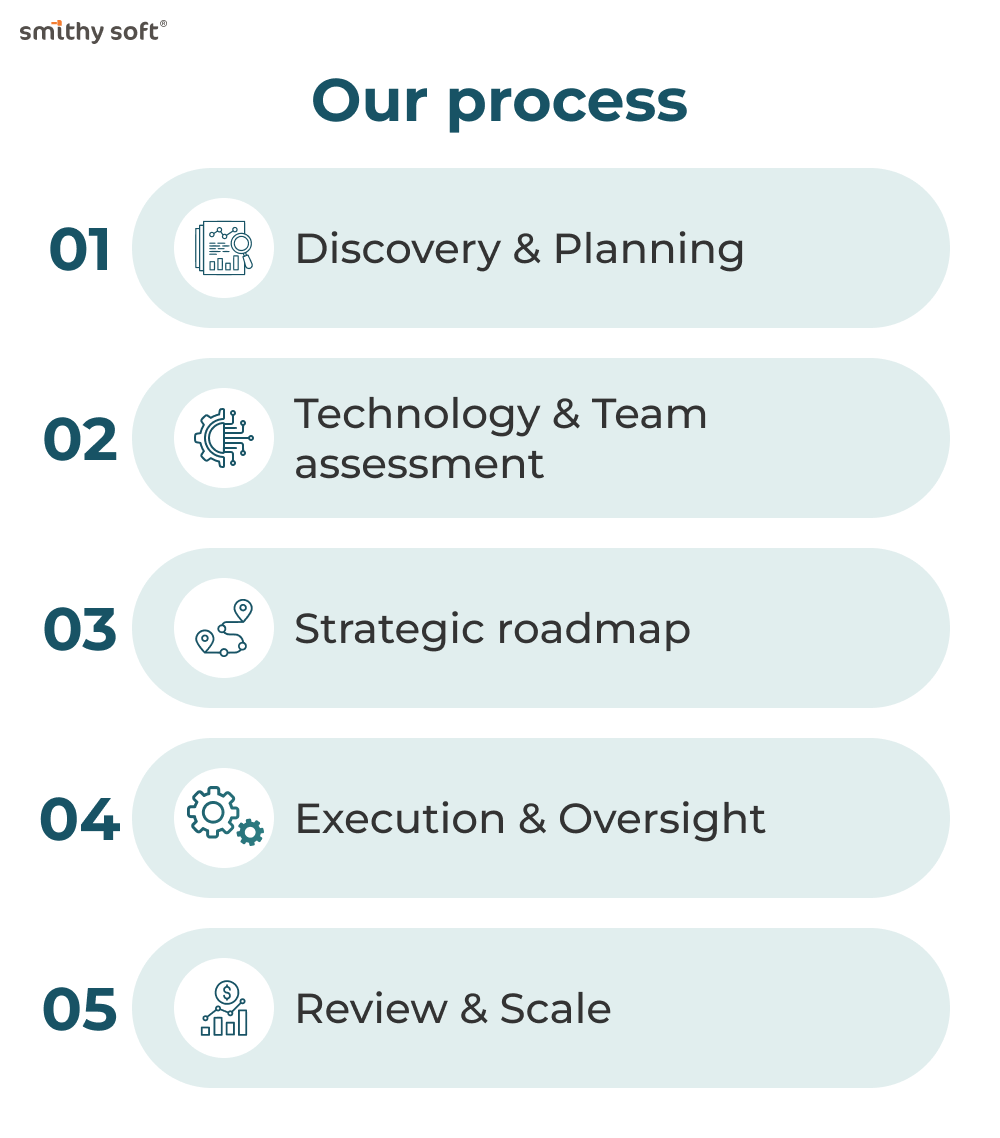
1. Discovery & Planning
We begin by learning about your business goals, technical challenges, and existing processes. This stage helps us define a clear scope, align expectations, and set the foundation for a focused engagement.
2. Technology & Team assessment
A full review of your current tech stack, infrastructure, and team capabilities. We identify what’s working, where the gaps are, and what’s needed to support your product and business strategy moving forward.
3. Strategic roadmap
Based on insights from discovery, we create a detailed, actionable technology roadmap. This includes priorities, timelines, resource planning, and clear milestones that align with your business objectives.
4. Execution & Oversight
We provide ongoing leadership and hands-on support throughout implementation. From technical decision-making to cross-team coordination, we ensure projects stay on track and deliver real value.
5. Review & Scale
Once key initiatives are delivered, we evaluate outcomes, refine strategies, and help scale systems and processes to support your next stage of growth. Long-term success is built on continuous improvement.
Conclusion
Benefit from CTOaaS at every stage of your startup’s development! SmithySoft offers CTOaaS for startups and small-to-medium businesses. Whether you’re just building your MVP or scaling operations, we adapt their leadership and services to your stage — helping you avoid many common early-stage missteps.
If your startup needs technology leadership that’s strategic and practical, without the full-time cost and commitment of hiring a CTO immediately, SmithySoft’s CTOaaS offers a scalable, expert solution. You gain a partner who brings executive-level thinking, startup agility, and a clearly defined path from tech strategy to execution.
💡 Ready to talk? SmithySoft invites you to book a call to explore how CTOaaS can help your startup scale smarter, streamline development, and stay ahead of the competition.