 Set as preferred source


AI-powered cyberattacks are no longer emerging - they are already operating at scale in real-world environments. Across 2025–2026 industry reports:
- 63–87% of organizations report experiencing AI-assisted attacks, including automated phishing, AI-generated malware, and AI-driven reconnaissance.
- ~80% of phishing campaigns now use AI-generated content, significantly increasing success rates through personalization.
- Attack volume is accelerating, with AI-driven attacks growing ~70% year-over-year.
At the same time, the structure of attacks has fundamentally changed. Attackers are moving away from mass, generic attacks toward AI-powered, micro-targeted campaigns, where each message, payload, or exploit is tailored to a specific individual or organization.
Attacks are now adaptive, non-repetitive, and continuously evolving. They do not follow fixed signatures, they do not wait for detection, and they can adjust in real time.
Attack velocity has compressed dramatically. In leading threat reports, average breakout times have dropped below 30 minutes, with some attacks progressing from initial access to lateral movement in minutes.
As a result, in 2026, the situation looks like this:
- Security is no longer about preventing breaches. It is about operating in an environment where breaches are continuous, adaptive, and increasingly automated.
- The primary constraint is no longer tooling - it is the ability of organizations to respond at machine speed.
- Cybersecurity is moving from protection → resilience.
AI attacks are already in production
Artificial intelligence in cyberattacks is already embedded in real-world attack workflows across industries. Documented examples:
1. AI-generated phishing at scale
Attackers are using large language models to generate highly personalized phishing emails that mimic internal communication styles.
Example:
Emails crafted using real LinkedIn data, company announcements, or role-specific language
Messages that reflect tone, formatting, and context of real colleagues.
These campaigns are no longer generic “reset your password” emails - they are context-aware and role-specific, significantly increasing success rates.
2. Deepfake-based social engineering
AI-generated voice and video are already being used in fraud.
Example:
Attackers cloning a CEO’s voice to request urgent fund transfers.
Fake video or audio calls impersonating executives in finance workflows.
These attacks bypass traditional verification methods because they exploit trust in human identity, not just systems.
3. AI-assisted vulnerability discovery
AI models are being used to identify and exploit software weaknesses faster than traditional methods.
Example:
Automated scanning of codebases and public repositories.
Identification of misconfigurations or exploitable endpoints.
Generation of exploit scripts without deep manual expertise.
In some cases, AI has demonstrated the ability to find previously unknown vulnerabilities at scale.
4. Adaptive malware and evasion
Malware is becoming more dynamic.
Example:
Code that changes behavior or structure to avoid detection.
Payloads that adjust based on the environment they encounter.
Variants generated automatically to bypass signature-based defenses.
This reduces the effectiveness of traditional detection systems.
5. End-to-end automated attack chains
Perhaps the most important shift: attacks are becoming fully integrated systems.
Example:
AI systems performing reconnaissance → generating phishing → gaining access → moving laterally → adapting based on response. Minimal human intervention once the process is initiated.
This is no longer a sequence of manual steps - it is an automated pipeline.
These examples illustrate a deeper change. First, capability is no longer constrained by skill. AI lowers the barrier to entry, enabling less sophisticated actors to execute complex attacks. Second, attacks become systems, not events. They are continuous, iterative, and capable of learning.
AI is not just enhancing attacks - it is operationalizing them. And once a capability becomes operational, it spreads. We are no longer preparing for AI-driven cyber threats. We are already operating within them.
Attacks become mass-personalized
For years, most cyberattacks followed a simple logic - often described as “spray and pray.” The idea was straightforward: attackers would send out large volumes of generic emails or malware, hoping that a small percentage of targets would fall for it. These campaigns were mass, cheap, low-quality. If even 1–2% responded, the attack was considered successful. This model worked because scale compensated for low precision.
At the other end of the spectrum were targeted attacks. These were:
carefully crafted, tailored to a specific organization or individual, significantly more effective. But they came with a cost: they required time, skill, and manual effort. Because of this, attackers had to choose: scale (cheap but inefficient), or precision (effective but expensive).
AI removes this constraint. Today, attackers no longer need to choose. They can generate thousands of highly personalized attacks simultaneously, each tailored to a specific person, role, or company - without a proportional increase in effort.
A phishing message can now:
- reflect internal communication style
- reference real company events or data
- match tone, language, and formatting of trusted contacts
What used to be a mass email has become a context-sensitive interaction. Each target receives something unique.
This creates a fundamentally new category: attacks are no longer mass or targeted. They are mass-personalized.
And this is not just a technical improvement - it changes how attacks behave. Instead of relying on probability, attackers now rely on relevance. Instead of sending one message to thousands, they send thousands of variations - each optimized for a specific target.
Why this breaks detection and human defense
Traditional security systems depend on repetition. They assume: attacks reuse infrastructure, payloads look similar, behavior follows recognizable patterns.
Mass-personalized attacks break these assumptions. They are: unique by design, continuously generated, adapted based on feedback. There is no stable template to detect. Even if one variant is identified, the next one may already be different.
User awareness has long been a critical layer of defense. It relies on the idea that people can recognize suspicious signals: unusual wording, bad grammar, common queries.
AI removes those signals. Messages can now: sound natural and fluent, reflect real context,
mimic trusted identities. The problem shifts from spotting obvious threats to detecting subtle inconsistencies under pressure. This is significantly harder - and not scalable.
Cybersecurity models were built for a world where attackers had to compromise between reach and accuracy. That world no longer exists.
What cybersecurity is really about now
The role of cybersecurity is being redefined - not as a response to theory, but to measurable changes in how attacks operate.
It is no longer about stopping every attack. That objective does not scale in an environment where: attacks are generated in real time, each attempt is different, and execution happens at machine speed.
Instead, the goal shifts. Cybersecurity is becoming less about prevention and more about limiting damage. The key questions are no longer: Can we stop this attack? But: How quickly can we detect it? How far can it spread? How fast can we contain and recover?
Rule-based security cannot keep up with adaptive threats. Modern cybersecurity requires systems that: learn from behavior, not just signatures, adjust in real time, respond automatically where possible.
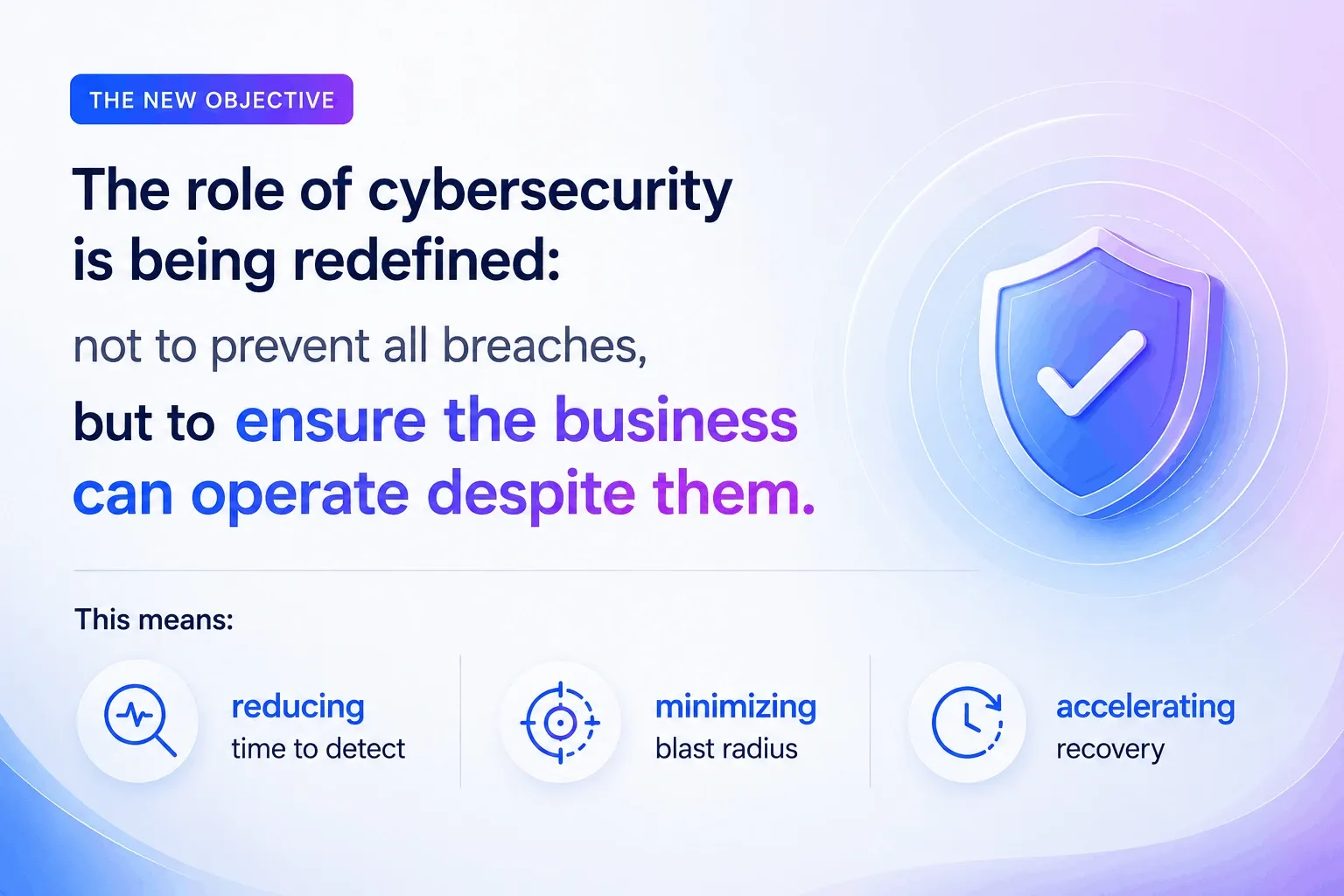
In other words: defense needs to operate at the same speed as attack. Iin an AI-driven threat environment, resilience - not prevention - defines security.
How to build cybersecurity for an AI-driven threat environment
The answer is not a single tool. It is a combination of architecture, processes, and AI-native capabilities.
1. Start with visibility, not perimeter
Most organizations still invest in blocking attacks at the edge. That is no longer sufficient. When breaches are inevitable, the priority becomes: knowing what is happening inside your systems in real time.
What this means: centralized logging (SIEM), real-time monitoring across cloud, endpoints, identity.
Tools:
- Splunk / Microsoft Sentinel / Elastic SIEM
- Datadog Security Monitoring
👉 Without visibility, response is impossible.
2. Move to identity-centric security (zero trust)
AI attacks often bypass infrastructure and target people. That makes identity the new attack surface.
What to implement: zero trust architecture, least privilege access, continuous authentication.
Tools:
- Okta / Azure AD (Entra ID)
- Cloudflare Zero Trust
- Zscaler
👉 If identity is compromised, perimeter defense doesn’t matter.
3. Automate detection and response (SOAR + AI)
Human response is too slow. You need systems that: detect anomalies automatically
trigger actions instantly.
What this means: automated playbooks, AI-assisted threat detection.
Tools:
- Palo Alto Cortex XSOAR
- Splunk SOAR
- Microsoft Defender XDR
- CrowdStrike Falcon
👉 The goal is not faster humans - it’s fewer humans in the loop.
4. Design for containment (assume breach)
The question is no longer if an attacker gets in - but how far they can go.
What to implement: system segmentation, strict access boundaries, isolation of services.
Practical approaches: microservices isolation, container security (Kubernetes policies), network segmentation.
Tools:
- Illumio / Tetrate
- Kubernetes Network Policies
- AWS Security Groups / VPC segmentation
👉 Limit blast radius, not just entry.
5. Secure the human layer (AI vs AI)
Phishing and social engineering are now AI-powered. Training alone is not enough.
What to do: simulate real attacks, detect behavioral anomalies, verify identity dynamically.
Tools:
- Darktrace (behavioral AI)
- Abnormal Security (AI email protection)
- Proofpoint / Mimecast
👉 You can’t expect humans to detect AI-level deception.
6. Protect the AI stack itself
New attack surface: your own AI systems. Risks: prompt injection, data leakage, model manipulation.
What to implement: input/output filtering, model monitoring, access control.
Tools:
- Lakera AI (prompt security)
- Protect AI
- Microsoft AI security controls (Azure AI)
👉 AI systems need security just like infrastructure.
7. Optimize for recovery, not just defense
Even the best systems will fail under pressure. Recovery becomes critical.
What matters: backup strategy, disaster recovery, system redundancy.
Tools:
- Veeam / Acronis
- AWS Backup / Azure Backup
👉 Downtime is now the real cost of cyber risk.
The new security stack in 2026
The 2026 security stack is no longer built around a single perimeter. It is built around one assumption: attacks will happen, and the system must detect, contain, and recover faster than the attacker can expand.
That changes the architecture of cybersecurity.
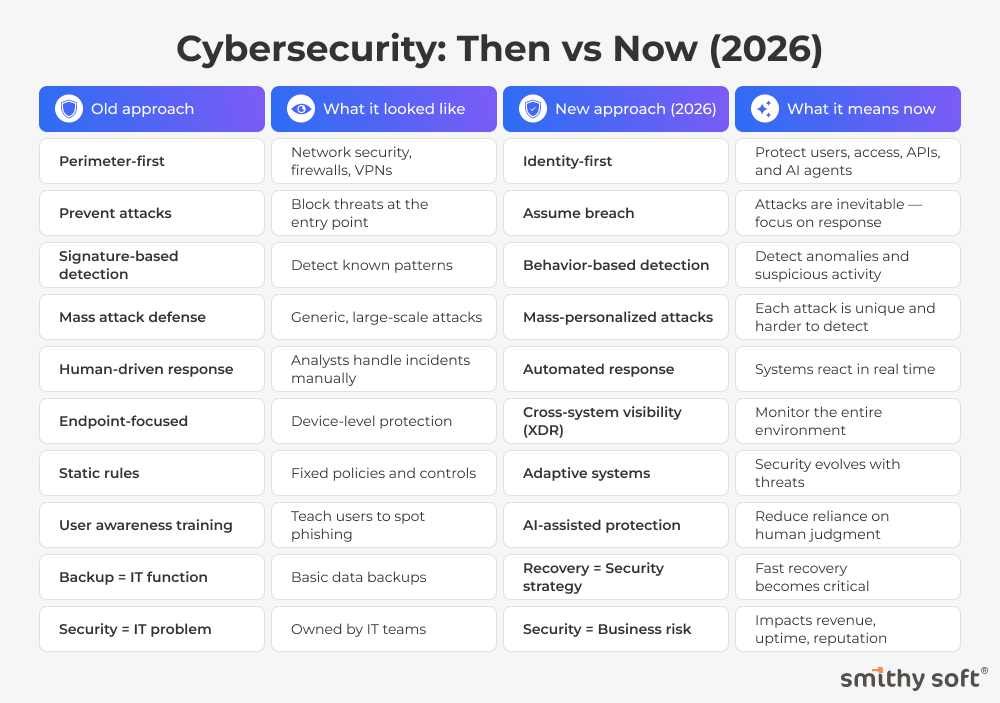
❗The question is no longer “How do we stop attacks?”. It is: “How do we continue operating when attacks succeed?”
Conclusion
Cybersecurity is no longer about preventing attacks. That model worked when threats were predictable and slower. In 2026, they are continuous, adaptive, and operate at machine speed.
Breaches are no longer exceptions - they are part of normal operations. This changes the goal. It is no longer about stopping every attack. It is about detecting faster, containing impact, and recovering without disruption.
The organizations that win are not the ones with the strongest defenses. They are the ones that can operate under constant attack.
SmithySoft helps companies build systems that are secure by design — from architecture and cloud to AI applications — so they can detect, contain, and recover from threats by default.
If you are strapped for time and just want my team to do it for you, book a discovery call.